

Looking beyond my full plate




~guest post by MRS
As I was sitting down to eat Thanksgiving dinner with my family last week, I started thinking. Not about the amazing food I was about to eat (although the food was amazing), but about the 1 in 6 people in our country who regularly don’t get enough to eat.
It’s easy to stand on our soapboxes and talk about the ineffectiveness of entitlement programs, i.e. food stamps or how people just need to get a job to feed their family. It’s also easy to get caught up in the arguments about food and farming. We should all eat only local, organic foods or conventionally grown food is fine or that all GMO foods need to be labeled as such. And while I understand that these are things that people are passionate about, sometimes I wonder if we’re focusing on these “secondary” issues a little too much.
Because, seriously, there are people in our own communities who are going hungry! Isn’t it more important that people are fed than whether or not they’re eating GMO or non-GMO food? I imagine that if you went up to a parent who was struggling to feed his children and offered that parent food, regardless of what kind it was, that the parent would be grateful just to be able to feed his children. I know I would. It breaks my heart to think about even the possibility of not being able to feed my children, and yet for some parents that is a daily reality.
It took a little bit of the joy out of my Thanksgiving dinner to think that while my family had more than enough to eat, my neighbors might have nothing. And as I thought about the arguing and in fighting that seems to permeate the food & farming industries, it all seemed just a little silly to me.
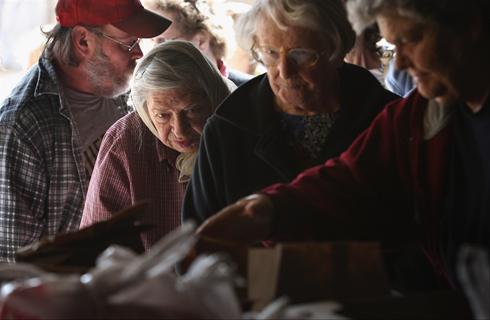
Who is hungry in your community?
Why can’t we focus on making sure that there is enough, affordable food for everyone before we get caught up in the organic vs. conventional, GMO vs. non-GMO, etc. debates.
I realize that it’s a tall order to make sure everyone has enough to eat. I also know that it’s overwhelming to think about feeding all 7 billion people in the world, and that for a lot of people, myself included, it’s easy to look at that number and be so overwhelmed that I do nothing. It’s also easy to get so caught up in my own life that I forget to think about what other people might be going through. So I thought to myself, “What can I do, in my community, to help, even in a small way?” And I realized there’s a lot I can do. I can volunteer at and donate to my local food pantry. I can give money, even if it’s just a small amount, to my church’s “Care & Share” fund. Most importantly, I can stop making excuses for why I can’t do anything and instead, make it a priority.
What can you do to help feed the hungry in your community?
1 Comment
Leave a Comment
You must be logged in to post a comment.


I couldn’t agree more. If you are hungry, it doesn’t make a hoot if you eat GMO foods, conventional foods, or organic. And some homeless people actually live off scraps in their local dumpster, how healthy is that! I donate food to food banks, actually work the food line at a local rescue mission during holidays, and offer those in need work around my house, such as mowing my lawns, in exchange for cash payment. We are all in this together. We can all pontificate about the pros and cons of food production and methods, but those with grumbling bellies can’t afford to be erudite.