Food Bullying Podcast

Health & environment priorities to beef producer: Episode 109




Grain-finished beef is safe, nutritious, and more sustainable than you think
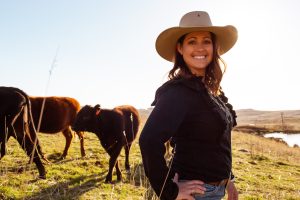 Alli Fender left a corporate veterinary technician career in 2022 to become her own boss as a direct-to-consumer beef producer and Black Angus breeder at the Flying F Ranch in San Diego County, California. She juggles that with motherhood, showing and breeding Australian Shepherds, and hosting the Agripreneur Empire Podcast on small business in agriculture.
She also spends a significant portion of her time explaining – patiently, repeatedly – why grain-finished beef is not the inferior, chemical-laden product that food fear content suggests. Her background in animal medicine gives her a precise vocabulary for those conversations, and her operation in one of America’s most drought-prone agricultural counties gives her a practical framework for why different finishing methods exist for different environments.
She joined the Food Bullying Podcast to address the hormones and antibiotics misconceptions directly, explain how her cattle eat beer waste in a way that keeps food out of landfills, and make the case that all beef – grass-finished, grain-finished, organic, or conventional – is safe, nutritious, and worth eating.
Grain-finished vs. grass-finished: the nutritional difference is minimal
The consumer assumption that grain-finished beef is nutritionally inferior to grass-finished beef is not well supported by the science – and Alli is candid about that even as someone who personally prefers the flavor of grain-finished beef.
The nutritional differences between the two finishing methods are, in her words, very minuscule. Not anything consumers need to make major dietary decisions around. The choice comes down to personal taste preference and what fits a given lifestyle – not a meaningful health distinction.
What does differ significantly is the time required. Grass-finished cattle can take up to 24 months or longer to reach market weight. Alli’s grain-finished cattle are typically done around 15 months. In San Diego County, where drought conditions make it environmentally irresponsible to graze cattle on already-stressed land for extended periods, finishing on grain is a sustainability decision as much as a business one. Her pastures stay healthier because her cattle aren’t on them longer than necessary.
For dietitians advising patients on beef choices, the resource beefresearch.org provides evidence-based guidance on the different kinds of beef available and what the science shows about their nutritional profiles.
What beef actually delivers nutritionally – in a three-ounce serving
A three-ounce portion of beef – roughly the size of a deck of cards – delivers a patient’s daily value of protein along with ten essential nutrients: zinc, iron, B6, B12, niacin, selenium, and others. Alli’s comparison for context: getting the equivalent protein from quinoa would require three cups of cooked product. The caloric efficiency and nutrient density of beef make it particularly valuable for active people, and the satiety factor – what some dietitians describe as the satisfaction dimension of red meat – means patients are less likely to return to the kitchen an hour after a beef-containing meal.
The beef councils of every state fund research and produce practical resources that translate this nutritional science into consumer-facing content, recipe ideas, and guidance on less familiar cuts. Alli points to beefitswhatsfordinner.com as a reliable resource for both dietitians and the patients they advise.
How cattle turn brewery waste into high-quality protein
San Diego County has over 400 craft breweries – more than any other county in the United States. Every one of them produces spent brewer’s grain as a byproduct of the beer-making process. That grain has two disposal options: pay to have it hauled to a landfill, or give it to a rancher.
Alli picks up a full trailer load from a local brewery approximately once a week, free of charge. The relationship is symbiotic – the brewery avoids disposal costs, the ranch gets a high-quality feed supplement.
The reason cattle can use this byproduct more effectively than most other animals is their ruminant digestive system. Cattle have a specialized multi-chamber stomach that can break down and extract nutrients from materials that are indigestible to pigs, chickens, and humans. Spent brewer’s grain is high in protein, fiber, and energy – and cattle convert it into beef. Alli feeds it to both her breeding cows, where it supports body condition and milk production, and to calves during the weaning and backgrounding phase, where it helps them maintain weight through the stress of separation.
This is upcycling in its most literal form: a waste product from one food system becomes an input for another, keeping material out of landfills while producing high-quality protein. It’s the kind of sustainability story that almost never surfaces in food media coverage of beef production.
Hormones and antibiotics: what Alli’s operation actually does
Alli’s veterinary background shapes how she handles both topics, and her approach mirrors responsible animal husbandry practices across the industry.
On antibiotics: Flying F Ranch does not add antibiotics to feed. Antibiotics are used only when an animal is sick – the same standard applied to a child who needs medication to recover. Every antibiotic carries a mandatory withdrawal period of approximately 45 days before an animal can enter the food supply. Any calf in her direct-to-consumer program that receives antibiotic treatment is removed from that program and kept for personal or family use – not sold. The residue testing that occurs at processing plants serves as the final verification layer.
On hormones: Flying F Ranch does not use growth hormones because its genetics produce well-performing cattle without them. Alli acknowledges that some feedlot operations use small hormone implants – roughly the size of a grain of rice placed in the ear – to accelerate finishing and reduce the resources required to bring an animal to market weight. The purpose is efficiency: the same amount of beef produced with fewer inputs. The use is regulated and the implants are removed before slaughter.
Pasture rotation, wildlife, and the environmental case for cattle
Flying F Ranch runs approximately 15 cows on at least 100 acres – a stocking density well within the recommended one cow per eight to ten acres for the region, made possible in part by the brewer’s grain supplementation that reduces pasture dependence.
The environmental benefit shows up in unexpected ways. Since practicing rotational grazing – moving cattle between sections and giving grazed areas rest periods to recover – Alli has observed an increase in wildlife on the property that she attributes directly to the habitat cattle grazing creates. Bald eagles have returned to the area. She’s seen deer, turkeys, weasels for the first time in years, and a rare burrowing owl-like species she struggles to name but has photographed. The biodiversity her pastures support is, in her view, one of the most visible signs that the land management is working.
Cattle hooves aerate the soil as they move across it. Manure fertilizes it. Rotational grazing allows grass to fully recover before the next grazing cycle, preventing the overgrazing that degrades land and contributes to erosion. Carbon sequestration happens in the soil as grass roots grow, die, and rebuild organic matter. These are not marketing claims – they’re observable outcomes of well-managed grazing systems that mainstream environmental coverage of beef production consistently ignores.
Connect with Alli Fender: Find Flying F Ranch on Instagram at @flying_f_ranch, visit flyingfranch.org, and listen to the Agripreneur Empire Podcast. For evidence-based guidance on beef nutrition, visit beefresearch.org.
Want to bring the real story of beef production, animal welfare, and sustainable ranching to your next event? Michele Payn speaks to agricultural organizations, agribusinesses, and dietitian associations on food bullying, busting food myths, and the science behind modern food production. Book Michele to speak →