

Local Food, Locavores & Hungry People




Looking Beyond Your Own Food Plate
Our family happily picked apples last week in an orchard 20 miles away, where we managed to taste Fuji, Yellow Delicious, Roma and Red Delicious on a bright Autumn day. We do the same with blueberries in July. We purchase eggs from our neighbor. We grow our own herbs, raspberries and vegetables – our family spends many hours in the garden to grow our own food. We also purchase beef from a local farm, enjoy pork burgers from the next county over and would love to find a lamb to buy. We enjoy local foods, once sold our goods at the farmer’s market and teach children about how to grow food.
Does that make me a locavore? I hope not – I’m not into being labeled and feel really strongly about freedom of food choices. Simply put, I don’t buy into the label of the day, “local.” I don’t believe one food plate is superior because it claims all the food is local (a claim to be seriously questioned if your zip code is in a cold climate and it’s February). I also refuse to give into the food guilt trips that food labeled local is worth 30% more or that we should only buy items grown within 90 miles because of carbon footprint. I’d suggest you do the math of a greenhouse tomato grown in New York in March, including all of the fuel needed to heat that greenhouse during snowfalls and 10-degree days, then compare it the footprint of a tomato trucked in from California. Take a look at this NY Times piece if you want more.
Don’t get me wrong, my first preference is tomatoes from our garden, but those are only available 25% of the year. As a mom, nutrition for my family is a top priority. Yes, I preserve food, but there’s nothing quite like fresh fruits and vegetables (not to mention the time constraints of a working mother). Call me selfish, but we like bananas – and believe it’s our choice to eat those bananas, even when grown thousands of miles away. I also feed our family strawberries trucked in from Florida in February. That’s our choice – just as I believe it should be your choice to buy the food that best fits your family’s needs and budget.

Millions around the world can't afford to worry about local food, like these squatter's camps in South Africa.
Pundits say we should keep the big picture in mind. I agree – let’s look at the really big picture of food insecurity, not just the trendy topics like carbon footprint. I’d encourage you to consider more that just your own food needs; it’s impossible to feed a world of 9 billion on small local operations. I had an interesting discussion with a national food editor last weekend at BlogWorld Expo about the challenge of food insecurity in a country where obesity is so prevalent. In a land filled with excess, it’s really hard for us to remember that there are people who live in fear of not being able to feed their children today – a number that’s increasing both in the U.S. and abroad. However, if you’ve ever laid eyes on the conditions that our fellow humans live in developing and Third World nations, you don’t soon forget the need to look beyond your own food plate.
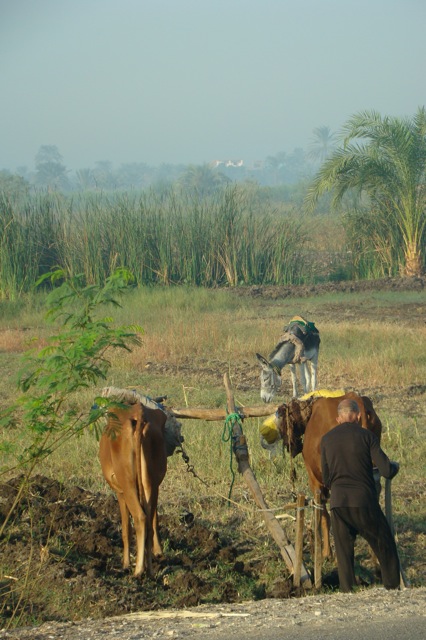
Farmer in Egypt working land - is this what we want to return to?
Local food is the pièce de résistance, but I’m not going to play into that movement if it compromises an agrifood system that’s designed to meet growing needs. I’m not so naive as to claim that there’s nothing broken in our food system; there are inequities, poor practices and marketing misinformation in the pursuit of higher margins at every level. However, an efficient agrifood system affords North Americans the luxury to clamor about issues that are relatively minor in the face of hunger, malnourishment and food insecurity.
World Food Day was October 16. Isn’t it far more important to make hunger awareness a movement than spending time labeling and judging what’s local and what’s not? Seek local food, grow your own if you wish, enjoy cooking as a locavore – but please don’t lose sight of the bigger picture – the need to feed an increasingly hungry world.
6 Comments
Leave a Comment
You must be logged in to post a comment.



I’d love the opportunity to engage in some discussion to find out if your “agrifood system” is sustainable.
There was insufficient data in the article, to know what this system looks like. You also make a claim that “It’s impossible to feed a world of 9 billion on small local operations.” Again, it begs data, so we can know what we are talking about when referring to “small local operations”.
Given that intensive small scale agriculture is the place where some of the greatest productivity can be found, it seems there’s some good discussion needed to clarify the terms.
I agree with your Michelle about labels. They don’t help with having an open mind about food production. I try to buy as local as possible. To me buying local means supporting keeping farmers in our area (large and small) as oppose to turning fields into houses. Buying local doesn’t necessarily mean you are buying from small inefficient farms. Our farm sells all of our products locally or regionally. We can have the inefficiency discussion at another time.
Rural areas are struggling socially and economically. When jobs leave (even farm jobs), so do the people. And when people leave so does the tax base to support basic community services. If by buying local means that one more farmer is able to hold on, it means that more taxes (mainly sales) and money circulate in a community. I want the areas around me to have strong schools, good fire and law protection and social services to help those in hunger. So, I buy local. It is my way of giving back to my community and helping an increasing part of rural America that lives in food insecurity everyday.
Yes, we too love a ripe banana and of course Tim loves his coffee. But we always make it a point to buy within the season of our region and supplement with a few treats from abroad.
Thank you for keeping us discussing big picture issues about agriculture and food production. It is fun to hear from all sorts of walks and opinions.
Emily
Michelle,
I appreciate that you are trying to both, something I also try to do in this house. While I wait with anticipation for the grapefruits to ripen on my tree, I am thankful that I can also get apples, which do not grow in my area. I get the impression from many that they feel they can’t do both. Why not?
[…] Source: https://causematters.com/advocacy/local-foods-locavores/ […]
[…] for more? Related Posts: Local Food, Locavores & Hungry People Balancing Harvesting & Parenting Reflections in Your Thanksgiving […]
[…] Hungry for more? Related Posts: Can an Organic Farm be Modern? Choice Local Food, Locavores & Hungry People […]