

Science Fair, Agriculture’s Story & Human Connections




Speaking out for agriculture doesn’t require a massive strategic plan. And frankly, you’re likely not the only one capable of advocating. I’ve recently observed commentary that farmers and ranchers are the only ones who can tell agriculture’s story. I don’t buy that. Each person has a right – and dare I say – a responsibility to tell their own story in agriculture. That story is different for a meat scientist in Pennsylvania, a seed salesman in Alberta, a rancher in Texas, a dairy woman in Michigan, a college student in Kansas – or a little person at a science fair.

Life events are great places to humanize agriculture.
Case in point: our “little tweep” loves science, along with dairy cattle. Those loves were combined this year for the long-awaited science fair project, which led to the little tweep telling people about both. The topic was “Do cows like corn or hay better?” She hangs out in in the milking parlor and feeds heifers enough to know that they are wild for grain and hypothesized that cows would like corn better because it was sweeter.
Cows definitely like corn better, as a barn trial confirmed during sleet after a very cold dairy judging practice. 50 grams of hay and 250 grams of cracked corn were measured in separate buckets on a gram scale (which froze during the last measuring while parental toes were numb). Little tweep offered the feed to each cows at the same time, timed the consumption on my iPhone and conversed with the bovines while recording results. The corn was inhaled, the hay ignored. Unanimously. Not a surprise to those who know cattle, but perhaps news who laud grass-fed as the only way to go.
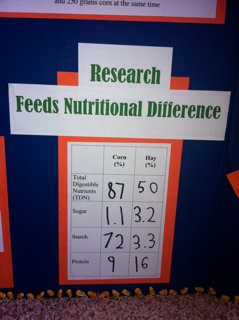 Research taught the little scientist that corn has more starch and total digestible nutrients while hay has more protein and sugar. Further exploration with human foods showed that hay is like green beans and corn is like oatmeal, which she drew pictures of on the display. Corn was painstakingly glued around the edges, the results carefully written up (for hours!) and she noted the need for a mix of feed. Her favorite journal page was the picture with the cow she helped show at age 1 1/2, captioned “This is my cow Panera, who turns corn and hay into milk, which gives us ice cream, cheese and yogurt. Yum!” She then had an interview with the judges to explain all she learned about her cow experiment. I didn’t personally witness it, but have been told she’s pretty clear in telling her story.
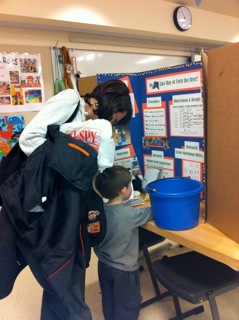 This proud mom will tell you the little tweep brought home a trophy (and a huge smile) – but that’s not what was important. It was about the effort and education. The little tweep was able to take something she loves, turn it into a learning opportunity and share it with others. When was the last time you’ve done that? The display was seen by hundreds at an open house – the cow (stuffed) was a magnet. Hopefully this provided a glimpse into the science of dairy cattle nutrition – and that it’s perfectly natural for cows to eat corn as part of a well-balanced diet. It’s amazing how few people understand that – even in a rural community.
I’m thankful that the little tweep is happy to tell her story – and that she thinks cows are cool. And I’m pretty sure that in her environment, she’s far more effective than any farmer, hardcore agvocate, agribusiness excecutive or even her professional speaker mother. Connecting farm to food is about human connections. At the end of the day, the only way agriculture wins is to have as many people as possible sharing their passion for – and firsthand knowledge of agriculture. Does it really matter what title you claim or what segment of agrifood you represent? I think not – it’s simply about finding places to connect with humans, whether it’s the science fair, Facebook, church meals, visits with elected officials or letters to the editor. How can you use simple events to share your story?
2 Comments
Leave a Comment
You must be logged in to post a comment.



What a great story!
I love that your little tweep had a question and sought out to find the answer… The first step of the scientific process. Then she collected data and shared her story, completing the process.
What are the follow up questions though? What happens if Panera consumes too much corn too quickly? Maybe that can be next year’s project.
Great idea and she understands that cows can get tummy aches if they eat too much of the good stuff, same as what happens to people. The little tweep has already informed us that she wishes to study plants and manure next year. More specifically, if plants grow better in soil with manure or fertilizer bought from the “store” or nothing. And, we’re apparently doing this in the dead of winter rather than our garden this summer. Love the creativity that science allows!