Sugar, salt & everything evil




Each August, in the midst of 90-degree humid Hoosier days and school starting, the Indiana State Fair rolls around. We take my daughter’s cattle to the ‘hood of downtown Indianapolis so she can be a part of the state 4-H dairy show (a beauty contest for cows).
Once we arrive, we unload several hundred pounds of hay, straw and tack, while getting everything set up for the cattle over the span of a couple of hours. Then I ask her the key question. “What’s our treat today?”
“Elephant ear,” is almost always her choice on the first day. Since elephant ears evoke memories of my own days as a 4-Her at the Hillsdale County Fair in southern Michigan, I happily oblige. You might be wondering what an elephant ear is; it’s piece of dough stretched into a large oval, deep fried and topped with cinnamon and sugar. The more cinnamon and sugar, the better!
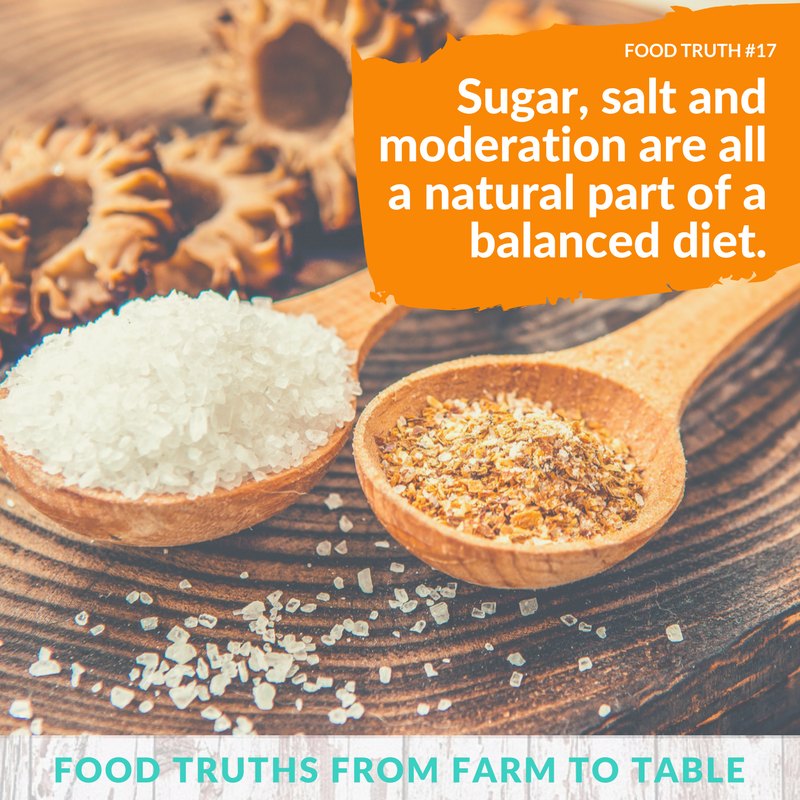
Let’s step back and define sugar. It is a simple carbohydrate. It has been consumed since the beginning of time. There are more than twenty individual, naturally-found sugars, which are known as monosaccharides. Glucose, fructose, galactose and ribose are the only four sugars absorbable into the human body.
Yet movies have been written about sugar, it is claimed to cause cancer, Food Babe chortles about sugars and Dr. Oz offers his opinion. MD Anderson Cancer Center at the University of Texas says “It’s true that sugar feeds every cell in our body —even cancer cells. But, research shows that eating sugar doesn’t necessarily lead to cancer. It’s what sugar does to your waistline that can lead to cancer.”
Rather than the ‘sugar is bad’ mantra, how about simply lessening our intake? Dietary Guidelines for 2015-2020 is to limit intake of added sugars to less than 10 percent of total daily calories instead of the 13-17 percent we currently consume.
What about salt? Did you know you would not be able to survive without salt? Sodium is an essential electrolyte; it maintains fluid balance and carries out vital functions such as regulating blood volume and nervous system activity, as well as ensuring healthy heart function and muscle contraction.
Salt is not produced by the body, so sodium in nutrition allows us to function. Table salt also contains a critical element that we do not get elsewhere—iodine. Iodine is required for brain and thyroid function and iodized table salt is recommended as the source of your sodium. Sea salt, as lovely as it is to cook with, has no iodine in it.
Salt is also a natural preservative, so it is often higher in canned and processed foods. For example, sodium nitrite is used to prevent botulism in cured meats. What’s the secret avoiding too much salt? Reading the label to know what products contain a lot of salt and adjusting your tastes to less sodium, and using products with less sodium.
Read more at Food Truths to Farm to Table and take a trip around the grocery store to be armed with 25 truths you urgently need to know about food so you can shop without guilt, confusion, or judgment. Learn the truths so you can recognize marketing and move on. A new book, Food Bullying, is expected late 2019.