Cut through the noise – find the truth about food and nutrition
You are standing in the grocery store aisle, reading a label, and feeling vaguely guilty. Cage-free. Hormone-free. Non-GMO Project Verified. Natural. You are not sure what any of it means — but you are pretty sure that if you buy the wrong thing, you are failing your family.
That feeling is not an accident. It was engineered.
There are more than 200,000 misleading marketing messages in a typical grocery store, and every one of them is designed to make you feel that your food choices are wrong — so you will pay more for the ones that feel right. Fear sells. Guilt sells. Confusion sells. And it is costing both consumers and farmers a steep price: one pays a premium for labels that don't deliver on their promises, and the other spends their career defending practices that were never actually the problem.
Food Truths is where that stops.
Here you will find what the science actually says about GMOs, pesticides, animal welfare, organic farming, food safety, and nutrition — written by someone who grew up on a dairy farm, has read the peer-reviewed research, and believes you are smart enough to handle the real answer. You will learn how food labels work — and how they are engineered to manipulate. And you will hear from the farmers, dietitians, and scientists who are telling the actual story about how food gets from the ground to your table.
This hub is built on an IPPY Gold Medal-winning book, 25 food truths grounded in science, and a clear conviction: you deserve accurate information and the freedom to make your own choices — based on your own values, your own budget, and your own family's needs. Not someone else's fear.
Separate food fact from fear. Know what you're actually buying. Enjoy your food again.
What you will find here:
- How to recognize the food marketing tactics designed to make you feel guilty
- What the science actually says about GMOs, pesticides, organic, and food labels
- Why "all-natural" means almost nothing - and what to look for instead
- Tools for dietitians to counter food fear with evidence and confidence
- How to make food choices based on your values, not someone else's agenda
Is the grocery store is lying to you? Here is what the science actually says.
Hormone-free chicken that was never allowed hormones anyway. Non-GMO Project salt with a 'paid to play' label.. All-natural products that are neither natural nor regulated. You are not confused because you are uninformed – you are confused because confusion was engineered by marketing.
There are more than 200,000 misleading marketing messages in a typical U.S. grocery store. They are designed to make you feel your food choices are wrong. That feeling has a name – food bullying – and once you can see it working, it loses most of its power.
This article covers what the science actually says about GMOs, hormones, pesticides, antibiotics, organic farming, animal welfare, and the labels engineered to make all of it feel frightening. Written by someone who works with dairy cattle, has read the peer-reviewed research, and believes you are smart enough to handle the real answer.
Podcast episodes
Ep. 129: Dairy safety and cognitive dissonance PhD microbiologist Andrea Love explains exactly what bird flu fragments in pasteurized milk actually means, why raw milk is the genuine risk, and how to explain the difference between hazard and risk to patients – from someone whose career is treating chemical and biological exposures.
Ep. 77: Chemicals and doctors and food, oh my! Emergency physician and medical toxicologist Dr. Liza Dunn states directly that glyphosate does not cause cancer, explains why pesticides protect public health rather than threaten it, and traces the history from DDT to GMOs through a public health lens that no agricultural advocate can replicate.
Ep. 128: Cutting through nutrition science noise PhD nutritionist Dr. Adrian Chavez – a former food fear convert – explains why seed oil panic and pesticide fearmongering are literally reducing vegetable consumption, and provides a clear hierarchy for evaluating nutrition claims by research type.
Ep. 125: The heart of the wheat kernel Dr. Brett Carver confirms with published research that wheat is not GMO, gluten has not changed in centuries, and the sensitivity many people attribute to gluten may actually be a FODMAP response – one of the most searched food questions in the country.
Ep. 111: Holistic animal agriculture for nutrition pros Colorado State sustainability scientist Dr. Kim Stackhouse-Lawson delivers the peer-reviewed answer to "would going vegan save the planet?" – 2.6% reduction in U.S. emissions – and explains why the biogenic methane cycle makes cattle fundamentally different from fossil fuel emitters.
Ep. 130: The gluten lie Kansas farmer-dietitian Heidi Wells dismantles gluten myths from both sides of the food system – she grows the wheat that her patients are afraid to eat – and explains how food misinformation ripples all the way back to the farm.
Ep. 121: Food labels & nutrition choices driven by dollars UGA food economist Dr. Chen Zhen reveals that 40% of the effect of nutrition labels gets quietly erased by retailer pricing – and that fruit and vegetable subsidies alone don't improve diet quality for lower-income households.
Blog posts
Why food makes you feel so guilty: Where that guilt comes from, what it is doing to your health, and how to put it down as you choose food for your family..
Do you buy food on shaming or your own standards? Food Truths from Farm to Table book excerpt – Michele's "know the farmer, know the science, know the system" framework applied directly to grocery shopping guilt.
Different levels of food bullying, same answer: "you can't have that!" Food Bullying excerpt outlining the six levels of food bullies – from zealots stripping cereal from moms to keyboard cowards.
The side effects of weenie water & 5 million Google results Food Bullying excerpt on the real costs of food fear – confusion, guilt, higher prices, farm disconnect. Sharp, accessible writing that captures the book's core argument.
Food with a conscience: humane care and animal welfare Michele's personal account of a sick dairy heifer and what it reveals about the emotional reality of farming and animal care. Breaks down the "factory farm" narrative with lived experience.
The pain of paying for food Michele on the human cost of food pricing — for consumers trying to feed families and farmers absorbing input costs. Bridges both sides of the plate with empathy.
A dietitian's journey from school to farm Guest RDN Katie Caputo Serbinski describes her first ranch visit and why it changed her nutrition recommendations – the definitive post for the farm-to-dietitian connection.
The bad press about red meat Guest post tracing a personal journey from anti-red-meat bias to evidence-based perspective. Relatable entry point for general consumers and students new to food truth conversations.
Books
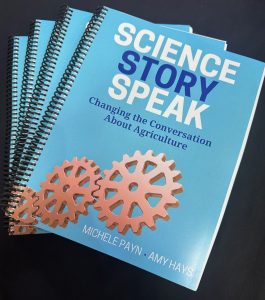
- Science Story Speak 180-page interactive workbook — 40+ exercises across 17 chapters for science-based communicators who want a real system.
- Food Bullying: How to Avoid Buying B.S. An exposé of how labels, brands, and online voices use fear and shame to manipulate food choices. It gives you simple tools to spot bullspeak, ignore bullies, and buy food that fits your own values.
- Food Truths from Farm to Table A myth-busting look at 25 “food truths” that cut through marketing hype and fear-based headlines. It helps you shop and eat with less guilt by pairing real farm stories with clear science.
- No More Food Fights! Bridge-building guide for farmers and food buyers — six senses for consumers, six steps for producers.
Speaking Programs
Every program is customized for your audience – whether you are working with farmers, scientists, dietitians, or the next generation of ag leaders.
Keynotes
- Translating Farm to Food: Creating a Different Conversation: Equips any audience to close the gap between farm practices and consumer understanding — covers animal welfare, GMOs, antibiotics, hormones, and sustainability in one unifying framework.
- Leading Forward: Nobody Warned You About This Part — Communication confidence and advocacy tools for the next generation of ag leaders.
- Celebrating Agriculture! — Uplifting keynote honoring the passion, promise, and purpose behind every farm operation.
Workshops
- Harvesting AI: Predict Food Trends, Protect Farming's Truth — Teaches agricultural communicators to use AI as a forecasting tool while protecting farming's authentic story from machine-generated misinformation.
- Science Story Speak Workshop — Teaches participants to simplify complex science and tell compelling stories that reach consumers, policymakers, and media.
- Championing Agriculture — Strengthens the ability to address contentious issues on social media, in policy discussions, and face to face.
Frequently Asked Questions (Render as accordion on live page)
Q8. What is food bullying and how do you recognize it?
Think about the last time you felt guilty standing in the grocery store – staring at a label, wondering if you were about to poison your kids. That guilt didn't come from science. It was put there. Food bullying is when marketing language, peer pressure, celebrity claims, or misleading labels are used to make you feel judged or afraid about your food choices – not to inform you, but to sell you something. It ranges from scare-tactic labels like "toxic" applied to perfectly safe ingredients, to social media shaming over what you feed your family. Six levels of food bullying are documented in Food Bullying: How to Avoid Buying B.S., along with a six-step action plan for pushing back. Once you can name the tactic, it loses most of its power.
Q9. Are GMOs safe to eat?
Yes – and this is one of the most thoroughly studied questions in modern food science. Every major independent scientific body that has reviewed the evidence – the National Academy of Sciences, the World Health Organization, the American Medical Association, and others – has reached the same conclusion: GMO foods currently on the market are safe to eat. More than 30 years of research across hundreds of studies supports this consensus. The legitimate debates about GMOs involve specific environmental applications, intellectual property, and agricultural policy – not whether they are safe to consume. The fear is real. The danger is not.
Q10. Is organic food nutritionally healthier than conventional?
Here is something the organic label doesn't tell you: the research does not consistently support the nutritional premium. Comprehensive reviews, including a major Stanford meta-analysis, have found no significant nutritional differences between organic and conventional produce. Organic farming does involve real distinctions – different practices around synthetic inputs, different certification standards, sometimes different environmental outcomes. Those are legitimate reasons some people choose organic, and that choice is valid. But the health premium that justifies organic's higher price is largely a marketing story, not a scientific one. Your family will be just as nourished by either.
Q11. What does "all-natural" mean on a food label?
Legally, almost nothing. The FDA has no formal definition for "natural," which means manufacturers can apply the term broadly – including to heavily processed products most people would not consider natural. It is one of the most misleading terms in the grocery store precisely because it sounds authoritative while carrying no regulatory standard. When you see "all-natural" on a label, look past it to the actual ingredient list. That is where the real information lives.
Q12. Are pesticide residues on produce dangerous?
The scientific and regulatory consensus is no – not at the levels present on food. The EPA sets allowable residue levels; the USDA and FDA test produce regularly. The vast majority of conventional produce tests well below safety thresholds, and much of it shows no detectable residues at all. There is a meaningful difference between "this chemical was present" and "this level poses a health risk" — and food fear marketing collapses that distinction deliberately. Washing produce is always sensible. But fear of residues should never lead anyone to eat fewer vegetables. That trade-off consistently goes the wrong direction for health.
Q13. Why is there so much misinformation about food?
Because confusion is profitable. A $5.75 trillion global food industry depends on consumers believing some food is dramatically superior – which requires making other food seem inferior or dangerous. Fear-based marketing drives premium product sales. Alarming food stories drive media clicks. Influencer food content drives commissions. None of this requires scientific accuracy. It requires only that you feel uncertain enough to seek reassurance and scared enough to pay for it. This is not conspiracy — it is capitalism applied to your anxiety. Understanding the system is the first step to stepping outside it.
Q14. What should dietitians know about navigating food claims with clients?
Your clients are arriving pre-convinced — by documentaries, social media, and product marketing that often has no scientific basis. Evidence-based guidance alone is not always enough, because the food fear they have absorbed is emotional, not informational. Dietitians also need tools to counter that emotional pull and to connect clients with the real story behind food production. The training programs Don't Buy B.S., Finding Food Truths, and Knowing the Source are built specifically to equip RDNs with both the science and the communication tools to serve as the trusted voice their clients need — and aren't finding anywhere else.
Q15. How can parents stop feeling guilty about food choices?
Start here: the guilt is a feature of the system, not evidence that you're making bad choices. Food marketing is engineered to make you feel inadequate so you'll pay the premium. The truth about food is less scary and more nuanced than the labels suggest. Armed with a few food truths grounded in science, most parents find the grocery store far less stressful — not because they know everything, but because they have stopped letting the packaging decide how they feel. The goal is not perfect choices. It is informed ones, made on your terms, based on your own social, ethical, environmental, and health standards. That freedom belongs to every family regardless of budget.
About Michele Payn
• International speaker on agriculture communication
• Author of Food Truths from Farm to Table, Food Bullying, and Science Story Speak
• Founder of #AgChat and #FoodChat
• Advocate for rural mental wellness