

Junk Journalism & Sound Science




Perhaps it was my recent time speaking at Michigan State and walking the halls of my alma mater that brought on this rant. Or maybe it’s constant exposure at airports to news that relies or sensationalism and fear. Then again, it could have been this excellent blog post by a former L.A. Times journalist that points to sloppy science and sloppier reporting.
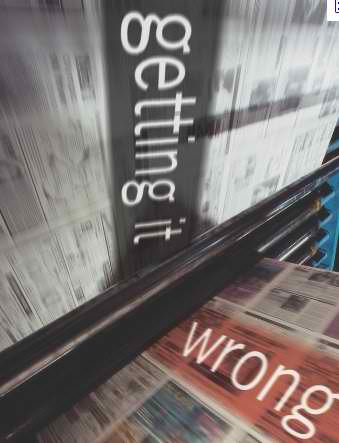 What the heck has happened to our country? Mainstream media, apparently in a quest to retain their business models of yesteryear, finds the worst possible angle of any story in an attempt to attract readers/viewers/listeners. It seemingly doesn’t matter if there’s only one source, if it’s blatant opinion piece by a reporter (once seen on the op ed page) or if the “study” behind a story is valid – as long as they have “news” to get people worked up.
Just for the record, one of my degrees required that I take journalism classes. It was pounded into our heads that journalism is not about bias; a journalist’s job is to report all angles. I’m sure this won’t surprise you, but I was reprimanded more than once for inserting opinion into a piece. I also recall failing at least one journalism assignment because I did not follow the AP Style Book (which still sits in my office as a threat to the rules I now break on an hourly basis). I’ve talked with others holding Journalism degrees – and we wonder if those classes are no longer being taught? Or have journalistic ethics just been thrown out the window by the news industry?
It’s bad enough enough that poor writing is as common as texting, but do we really have to accept the lost art of journalism? Sensationalized opinion reporting seems to be more prevalent in the States, which also makes me question what’s wrong with our country’s standards. I don’t have the solution, aside from unsubscribing and using the off switch for media who employ these tactics.
Couple that with issues around society’s acceptance of science. Perhaps I’ve spent too much time on Twitter, but I suspect we are on a dangerous path that devalues science and overvalues opinion. It seems as though people either buy into any study that supports their opinion without question (case in point is the widely reported Harvard study that best selling author/former journalist Valdes calls sloppy) – or they completely distrust science. If we can’t trust science, then where does that leave us?
I spent five years working in the Reproductive Physiology Laboratory at Michigan State, with glamorous jobs such as washing thousands of pieces of lab glassware, processing mammary glands and giving cows boluses in the middle of the night. Though I was only an undergraduate grunt worker, I took part in rBST, melatonin and many other dairy/beef trials. It gave me a firsthand appreciation for the level of detail that studies require, how dedicated scientists are to their research and the very finite process involved in research in order for it to receive government/regulatory approval.
Claiming that most scientists sway studies based upon funding sources is ridiculous to me. Sure, there are bad apple scientists, just as there are poor teachers, parents, farmers and doctors. But doesn’t a scientist ultimately fail in their profession if they lack the ethics to conduct real science? Thus, the value of peer-reviewed science – and taking time to be diligent in checking how research weighs against popular opinion.
What you eat is your choice. Do your diet as you wish – meat or no meat. I simply ask your decisions be based on sound science, not junk journalism. Please be aware of articles stilted one way and get answers from experts. A journalist using shoddy science as their singular source to push opinion isn’t an expert – nor is a celebrity who became a food diva or the top result on Google. Experts can be found in the scientists researching inputs, farmers producing raw products, the processor making it into food and Registered Dietitians who have studied how it impacts human nutrition.
Now can someone please explain why we’re so willing to buy into sensationalized “news” while throwing science under the bus? I’d love to hear your ideas; I fear the outcome is an opinion-driven society that is either numbed into submission or overreacts to every claim.
7 Comments
Leave a Comment
You must be logged in to post a comment.


I too am a journalist and spent many years on the news desks at large newspapers in California. Sadly, today’s so called “journalists” have never had to study libel laws, AP style, news ethics, or any other of the demands of journalism that makes a good writer and reporter. Today, because everyone seems to have a blog and web pages, anyone can write anything about any thing or anybody, and not have to suffer the scrutiny of picky editors. And, also sadly, this means sensationalize stories, distorted facts to prove their points, and a whole list of bad habits and motives in copy you find online. So, all I can say is “READER BEWARE.” As always, “consider the source,” a good old fashioned j-school motto.
I spent 10 years working as a newspaper reporter in California. Online journalists are not the problem. Corporate Junk Journalism is the problem. Editors filled their newsrooms with reporters who all hold the same political views and who sit around congratulating themselves on their brilliance and criticizing their readers as stupid. The corporate journalist decides what stories are covered and sources for those stories and then denies bias affects this gate keeping function. Reporters use word placement and adjectives to either buildup or destroy the credibility of sources based on their own beliefs, and editors allow this to happen.
Web writers did not sensationalize the breast implant story and get it wrong. Web writers did not report the manufactured link between vaccines and autism without critique and with such enthusiasm that parents actually stopped vaccinating their children.
Web writers are not now sensationalizing the Trayvon Martin shooting. Look to NBC and ABC for creative editing of video and audio. More often than not, the web writers are keeping corporate folks honest, by exposing the bias and illogic.
AP Style is not a positive thing. It destroys engaging writing. Please name another business where competitors work to make their products look identical. My editors used to read the competition everyone morning and decide what was news and assign stories based on what our competitors were covering. If a competitor had a story, it was a must get. If we had a story our competitors did not have, it was uninteresting. Content did not matter. The least creative journalists live in the comfort of America’s newsrooms. They are lazy followers. That’s why we see networks and newspapers covering the same stories the same way every day. Thousands of valuable, compelling stories go unreported because editors chase their competitors and the reporters they hire are either too lazy, lack the time or lack the creativity to uncover real news.
Corporate editors and reporters use phrases like “consensus of scientists” or “global warming denier” when writing stories about climate. News flash! Consensus is not part of the scientific method. Because the science is weak and suspect in many cases, Junk Journalists resort to the “consensus” argument to marginalize those who disagree with the faulty science. When writing about people who disagree with the science, these Junk Journalists go further and label them as “deniers”. Junk Journalists rely on and often believe Junk Science.
Corporate Junk Journalism is a bigger threat to freedom and our society than corruption in government.
It amazes me how willing we are to allow our most basic health and nutrition decisions to be determined by headlines and trends. But then, there’s so much information around us, and it takes a long time to dig to find the reputable experts. It seems we don’t even rely on common sense or what our mothers and grandmothers taught us.
Irony: Today on RFD. A comment on pink slime testifies to the consumer’s preferences, followed by statistics about how our junk food and snacking equals about 1/3 of our food consumption. Go figure.
[…] Junk Journalism. Michele Payn-Knoper offers her personal perspective. […]
The supposed virtue of reporting ‘all sides’ of ‘an issue’ is grossly misleading, though it seems fair on the face of things.
Take, for example, genetic engineering of crops. Normally, advances in the field would be called news. The journalist who looks at this as ‘an issue’ is but one step away from shoddy journalism. The next step is to look at the issue ‘from all sides’, i.e., someone who opposes engineered crops must be found. They’re basically impossible to find in the scientific community, so the journalist turns to an anti-GMO activist.
The activist, who would not be even remotely be considered to be ‘peer’, as in peer-review, is suddenly raised by the journalist to a status equal to that of the scientists involved. If this were not bad enough, the activist will also provide the sensationalism that the story would otherwise lack.
Thus, reporting on ‘all sides’ of ‘an issue’ leads directly to shoddy journalism. The only remedy for this is to teach how responsible science journalism is done, and later, to insist on it. A brief look at the current quality of science journalism reveals that it is lamentably poor, if nonexistent.
Reporting on ‘all sides’ of ‘an issue’ should be reserved for the sports section.
These days, junk journalism operates on the idea that viewers/readers accept what is handed to them without question on any given science subject. When we see glitches in the reporting and ask tough questions about that, and receive answers that are nothing but evasive, we then have a massive problem on our hands.
I’m no journalist, but this problem has been so aggravating, I’ve taken to writing about it myself. The global warming issue in particular, seems to showcase precisely what is wrong with junk journalism, please see “PBS NewsHour: Climate Central a “research organization”; Sorry, no. They advocate solving man-caused global warming” http://junkscience.com/2012/03/23/pbs-newshour-climate-central-a-research-organization-sorry-no-they-advocate-solving-man-caused-global-warming/ and “Monumental fault in manmade global warming notion hiding in plain sight” http://junkscience.com/2011/12/24/monumental-fault-in-manmade-global-warming-notion-hiding-in-plain-sight/ and “PBS and Global Warming Skeptics’ Lockout” http://www.americanthinker.com/2011/08/pbs_and_global_warming_skeptics_lockout.html
As a scientist (physical chemist) I appreciate your respect for empirical science. As the son of a journalist (Mom was a a proofreader) I respect your understanding and love for journalistic professionalism.
As an experienced observer of human nature (mostly impartial due to Asperger’s Syndrome) I feel obliged to point out that most human beings are uncritical thinkers. They believe the first statement they hear on any given topic, holding it up as a dogma against which all latter pronouncements are measured. Consequently they are all too willing to accept without reservation anything that supports their uncritically accepted dogma, and only too willing to discard demonstrable facts that do not support it. Journalists are no better than the rest of the uncritical thinkers.
For a good overview of the elements of critical thinking I recommend James Lett’s Field Guide:
http://www.csicop.org/si/show/field_guide_to_critical_thinking/