






 From milk to cheese to spirits: the full-circle farm innovation at Redhead Creamery
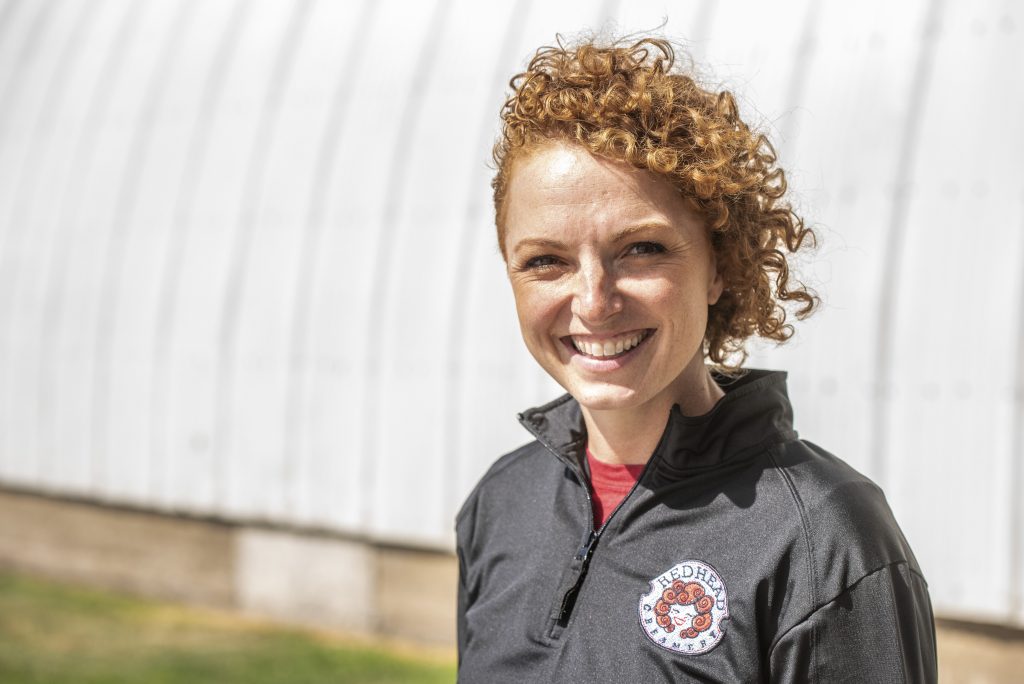
Most dairy farmers measure success in hundredweights of milk. Alise Sjostrom measures it in wheels of award-winning cheese, whey-based spirits, and the look on a tour group's face when they realize how little they understood about where their food comes from.
Sjostrom is the co-owner of Redhead Creamery at Jer-Lindy Farms in northern Minnesota, a farmstead cheese operation named for her parents, Jerry and Linda, who had the foresight to breed their Holstein herd for high fat and protein content 25 years before Sjostrom was ready to start making cheese. She studied at the University of Minnesota and the Vermont Institute for Artisan Cheese, trained at Grafton Village Cheese in Vermont, spent time in Switzerland immersed in European cheese culture, and came home to build one of the most vertically integrated small farm operations in the country – making cheese, producing spirits from whey, distilling water from the process, and feeding protein back to the cows that started the whole cycle.
She joined the Food Bullying Podcast to talk innovation, lactose misconceptions, antibiotics in dairy, and what it takes to build a business that can answer every question a skeptical consumer walks in with.
The biggest lactose misconception – and why cheesemaking proves it wrong
The most common misconception Sjostrom encounters: people who identify as lactose intolerant assume they can't eat cheese. The science of cheesemaking refutes this directly – and her whey spirits project inadvertently provides the proof.
When milk is converted to cheese, the whey – the liquid byproduct – carries away nearly all of the lactose. That's the sugar that ferments into alcohol when Sjostrom's team makes their whey-based spirit, Araga. Without lactose leaving the milk through the whey, there would be nothing to ferment. The implication for cheese eaters: a fresh cheese curd might trigger a reaction in a highly sensitive person, but an aged cheddar or a Parmesan contains virtually no lactose at all. The aging process completes what the wheymaking started.
Sjostrom plans to have her cheeses formally lab-tested for lactose content specifically to give customers data, not just reassurance. For dietitians counseling patients who have eliminated dairy entirely based on a lactose intolerance diagnosis, this is worth knowing: the diagnosis may not require giving up cheese.
The science of cheesemaking – from warm milk to wheel
Sjostrom's operation begins with milk piped directly from the barn to the cheese plant while the cows are still being milked. Milk exits a cow at around 100°F and arrives at the vat at roughly 91°F – warm, fresh, and minutes old.
The process from there follows chemistry that Sjostrom describes with a laugh, noting that she and her husband both failed chemistry in college and are now, professionally, doing advanced biochemistry every day:
Milk enters the pasteurization tank, is heat-treated, then cooled to around 95°F – the activation temperature for cultures. Cultures are bacteria that provide the specific flavor profile of each cheese variety, selected from potentially hundreds of options. After about an hour of culture growth, rennet is added. Rennet coagulates milk from liquid to a jello-like texture in roughly 40 minutes. The resulting mass is cut with large wire knives, separating solid curds from liquid whey. It takes approximately 10 pounds of milk to yield one pound of cheese.
From there, the process diverges by variety. A brie never gets cooked – the curd is stirred, poured into molds, and shaped. A cheddar is cooked to around 103°F and then "cheddared" – stacked into slabs that are flipped and stacked again as lactic acid develops and the pH drops, producing the characteristic cheddar flavor. The slabs go through a mill into recognizable cheese curds, are salted by weight, pressed overnight, and aged from three months to over a year depending on the intended product.
The genetics piece matters too. Jer-Lindy's Holsteins were already bred for high fat and high protein by the time Sjostrom was ready to make cheese – the ratio of fat to protein in the milk is critical for cheese yield. That 25-year head start was a genuine competitive advantage built by her parents without knowing exactly how it would be used.
Whey spirits: full-circle farm innovation
Most cheese operations treat whey as a byproduct to manage. Sjostrom's team treats it as a raw material.
After cheesemaking, the liquid whey – still containing nearly all the lactose and some protein – is currently fed back to the cows, adding sugar, protein, and palatability to their ration. The spirits project takes this further. Whey is collected and run through an ultrafiltration and nanofiltration system that separates lactose from protein. The protein goes back to the cows. The lactose goes into a fermentation tank, where lactase splits it into its component sugars – glucose and galactose – and yeast is added to ferment the sugars into alcohol over five days.
The resulting base is then distilled into Araga, a clear spirit with a creamy texture and slightly richer flavor than vodka. It's distinct from gin – similar structure, no pine notes – and the dairy origin is intentionally present in the flavor. Only around six producers worldwide are currently making whey-based spirits. Sjostrom is one of them.
The reverse osmosis filter in the same system produces pure water as a final output. The complete sequence from a single milking: milk → cheese → protein (back to cows) → whey spirit → pure water. Nothing is wasted.
Antibiotics, transparency, and the farm tour advantage
Jer-Lindy Farms uses antibiotics when cows are sick – the same standard applied to any sick animal, the same Sjostrom would apply to her children. The protocols are strict: treated cows are kept entirely separate, and their milk never enters the cheese supply. At the processing plant level, every batch is tested for antibiotic residue before use. If a contaminated load reached a processing facility, the farmer bears the cost of the entire tanker. The financial and regulatory incentives against antibiotic contamination are overwhelming.
What the farm tour does, in Sjostrom's experience, is make abstract reassurances concrete. Visitors arrive with assumptions shaped by social media and food activism. They leave having seen a functioning dairy farm, talked through the controversial topics directly, watched the cheese get made, and held a fresh curd. The biggest surprise for most tour groups, she says, is how much science and intentionality goes into every aspect of dairy farming. They didn't expect it to be sophisticated. It is.
Having the creamery on the farm has also elevated the operation's standards. Jer-Lindy was already well-managed, but knowing that public visitors could arrive at any time has made cleanliness and animal care even more visible priorities – a feedback loop that benefits the cows, the milk quality, and the business simultaneously.
What a female farmer and cheese innovator puts in her grocery cart
Sjostrom buys full-fat everything – her reasoning being that fat promotes satiety and reduces overall consumption. Her cart prioritizes meat, fruits, vegetables, and gluten-free grains, the latter because her daughter has celiac disease, which has made her a more careful and creative label reader than most. She doesn't see grocery shopping as a chore. She sees it as a hobby, spending a full hour exploring new products, seeking out gluten-free options worth eating, and scouting interesting items whenever she travels.
Her philosophy on cheese in the diet is characteristically practical: portion size matters, but the idea that cheese doesn't belong in a balanced diet is a misconception her business exists to disprove. A well-chosen cheese on a salad, stirred into a sauce, or melted into a sandwich makes food more satisfying and can help deliver nutrition – including dairy nutrition – to people who would otherwise skip it.
Connect with Redhead Creamery: Order award-winning cheese shipped anywhere in the country at redheadcreamery.com. Find them on Facebook and Instagram.
Want to bring the story of agricultural innovation, dairy farming, and food science to your next event? Michele Payn speaks to agricultural organizations, agribusinesses, and dietitian associations on food bullying, consumer trust, and the science behind modern food production. Book Michele to speak →
To learn more about Sjostrom or to order cheese, visit www.redheadcreamery.com. Find her on Facebook and Instagram.