





Making your agricultural knowledge matter to the rest of the world
A video goes up on a Tuesday. A self-described food activist with no farming experience films herself walking through a grocery store, explaining what farmers don't want you to know. By Friday it has three million views. Within a month, nine million people have seen it – and AI tools are already using it as a source, passing it on to every person who asks about how food is grown.
Meanwhile, the farmer who actually grows the food in that video has been up since 4 a.m. She knows exactly what went into producing it. She could answer every question the activist raised – accurately, from firsthand experience, backed by science.
She has not posted anything. Because calving started. Because the animals need care. Because that is what farming actually looks like.
That is not a farming problem. It is a communication problem. And it is one you can solve.
Misinformation about food production grows faster than most crops. The knowledge that could correct farm to fork communication exists – in barns, in laboratories, in the minds of the farmers, scientists, and food professionals who live this work every day. What it mostly lacks is a system for making it matter to the people who need it most. Here you will find that system: frameworks for finding the emotional connection point before you introduce the science, tools for telling your story without losing people in the data, guidance on agvocacy – including the movements that started here in 2009 with #AgChat and #FoodChat – and an honest look at what AI is doing to the food conversation right now.
These resources are for farmers who want their story heard, scientists who need to translate research for public audiences, dietitians navigating the farm-food divide, and ag communicators building trust in a skeptical world.
Your story is the most underused tool in farm to food communication. This is where you learn to use it.
Agricultural communication FAQs
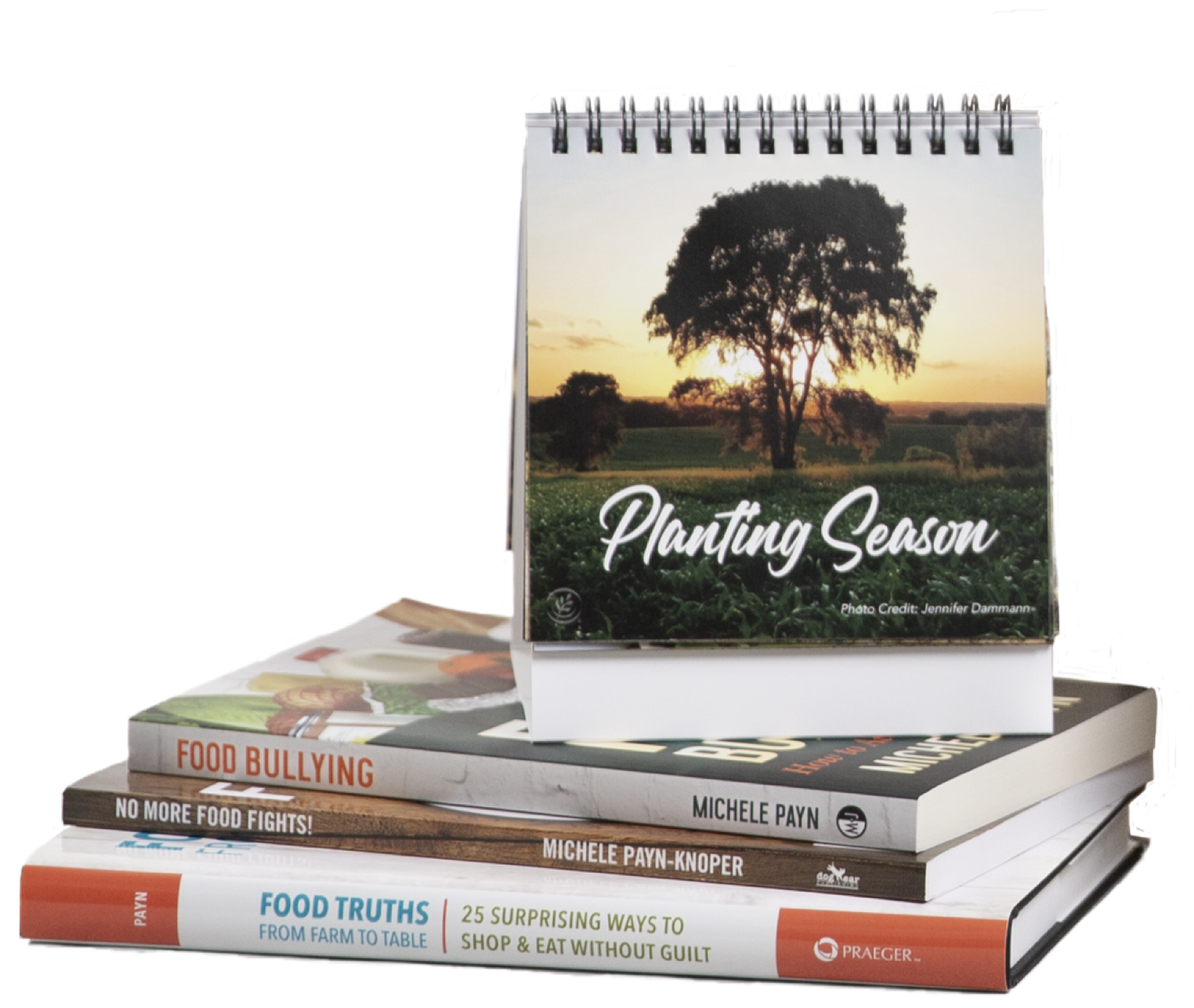
Michele's books to bridge the divide between farm and food
- Science Story Speak 180-page interactive workbook — 40+ exercises across 17 chapters for science-based communicators who want a real system.
- Food Bullying: How to Avoid Buying B.S. An exposé of how labels, brands, and online voices use fear and shame to manipulate food choices. It gives you simple tools to spot bullspeak, ignore bullies, and buy food that fits your own values.
- Food Truths from Farm to Table A myth-busting look at 25 “food truths” that cut through marketing hype and fear-based headlines. It helps you shop and eat with less guilt by pairing real farm stories with clear science.
- No More Food Fights! Bridge-building guide for farmers and food buyers — six senses for consumers, six steps for producers.
Speaking programs connecting agriculture and foodies
Every program is customized for your audience – whether you are working with farmers, scientists, dietitians, or the next generation of ag leaders.
Keynotes
- Translating Farm to Food: Creating a Different Conversation – Equips any audience to close the gap between farm practices and consumer understanding — covers animal welfare, GMOs, antibiotics, hormones, and sustainability in one unifying framework.
- Leading Forward: Nobody Warned You About This Part – Communication confidence and advocacy tools for the next generation of ag leaders.
- Celebrating Agriculture! – Uplifting keynote honoring the passion, promise, and purpose behind every farm operation.
Workshops
- Harvesting AI: Predict Food Trends, Protect Farming's Truth – Teaches agricultural communicators to use AI as a forecasting tool while protecting farming's authentic story from machine-generated misinformation.
- Take Food Bullying by the Horns: Gain the tools to combat misinformation by understanding neuroscience and neuromarketing around modern agricultural practices.
- Science Story Speak Workshop – Teaches participants to simplify complex science and tell compelling stories that reach consumers, policymakers, and media.
- Championing Agriculture – Strengthens the ability to address contentious issues on social media, in policy discussions, and face to face.
Food Bullying podcast episodes to give you perspective on food myths, truths, and misinformation
Insight from food scientists, RDNs, farmers, researchers and people who REALLY know food - and the science behind it.
Ep. 134: Food demons & dietitians as decongestants
International Food Information Council Senior Director Milton Stokes explains why leading with listening – not facts – builds more trust with skeptical consumers, and shares 19 years of Food and Health Survey data on who consumers actually trust for nutrition information.
Ep. 125: The heart of the wheat kernel
OSU wheat breeder Dr. Brett Carver describes how one misleading book nearly destroyed public trust in wheat overnight – and how he rebuilt his entire communication strategy around research to counter it. Learn about myths related to gluten, wheat breeding, and GMOs.
Ep. 133: Eat like a pig with high quality amino acids
NDSU meat scientist Dr. Eric Berg breaks down protein quality, the DIAAS score, what “high protein” food labels don’t tell you, and what a Western diet did to pigs – essential science for dietitians and agricultural organizations navigating meat and amino acid misconceptions.
Ep. 135: Science connecting dietitians & agriculture
Science communicator Amy Hayes and agricultural speaker & author Michele Payn explain why science literacy is the missing bridge between farmers and the dietitians who advise their customers – and how co-authoring Science Story Speak gave them a shared framework.
Ep. 119: GMOs, bacon & a side of bullying
Minnesota hog farmer Wanda Patsche built a loyal following by sharing her farm's story online with patience and facts – then describes the moment bullying came from other farmers and what it cost her to keep going.
Ep. 102: Farm monoculture myths & soil nutrients
Farmer-dietitian Jennie Schmidt explains how misinformation about monoculture and soil practices becomes bad agricultural policy when it reaches lawmakers unchallenged – and what RDNs can do to stop it.
Ep. 75: Good soil is like chocolate cake
Nebraska farmer Steve Tucker's "the elevator is not my consumer" reframe is one of the most quotable communication pivots in the series – a practical model for any farmer wanting to connect directly with the people eating their food.
Ep. 111: Holistic animal agriculture for nutrition pros
Dr. Kim Stackhouse-Lawson delivers peer-reviewed data on greenhouse gas emissions, the biogenic methane cycle, cattle as food waste upcyclers, and the federal funding gap that is slowing sustainability research in animal agriculture. The myths around methane and cattle are ripe with disinformation - learn more food truth here.
Ep. 105: Dietetic ethics, evidence & evolution of food information
Former Academy of Nutrition and Dietetics president Connie Diekman lays out three practical tools every communicator needs to navigate misinformation – and warns that the problem starts inside dietetic education itself. Identifying misinformation and disinformation arms you against being bullied around food.
Agricultural communication blog posts
Yes, farming is personal, but… A No More Food Fights! book excerpt making the case that farmers must treat the public as stockholders – and why defensiveness is a losing communication strategy. Timeless anchor content for the agvocacy argument.
What is the answer to food bullying and B.S. food? Introduction excerpt from Food Bullying – Michele's "know the farmer, know the science, or know the system" mantra presented as a practical communication framework. Strong call-to-action content for ag organizations.
Dear Mr. Pollan, farming is not a story Michele's firsthand account of 100 farmers reclaiming agriculture's narrative from a national pundit. A case study in agvocacy that still holds up.
National Geographic to farmers: be open to the public, listen more and tell your story Two-part interview with a National Geographic editor on the farm-food disconnect – rare outside perspective on what consumers actually want to hear from farmers. Useful credibility content for agribusiness audiences.
Back to school: teen's guide to sharing the farm story Michele's five C's framework (confidence, communication, cool factor, clarity, conviction) for FFA and 4-H members. Practical and search-friendly for the next-generation farmer audience.
Agvocates: people just like you National Ag Week roundup of real agvocates in action — farmers at soup kitchens, school visits, elected official farm tours. Humanizes the advocacy conversation with concrete examples.
Inspiration Michele's foundational piece on what drives the work — dairy farmers on Instagram, hog farmers fighting for their future, the agvocates who get her out of bed. Establishes the emotional core of this pillar.
About Speaker & Author Michele Payn
- Award-winning author of Food Bullying, No More Food Fights!, Food Truths from Farm to Table, and Science Story Speak
- Grew up on a dairy farm; holds a degree in animal science from Michigan State University
- Certified Speaking Professional (CSP) – one of 900 in the world
- Founder of #AgChat and #FoodChat – two of agriculture's earliest and most influential social media communities
- Host of the Food Bullying Podcast – 120+ episodes bridging farm and food worlds
- Worked across 25+ countries with agricultural organizations, agribusinesses, farmers, and dietitian audiences
- Raised $5M+ for FFA & 4-H through strategic communication and community development
- Created a wildflower pollinator business alongside her husband on their small farm in central Indiana
Cut through the noise: science-backed farm & food resources

Food Truths and Consumer Trust

Farm to Fork Communication

Sustainable Agriculture and Science