





Sustainability in agriculture is not a label
By Michele Payn, CSP | causematters.com
Sustainability is a practice. And the people practicing it have been doing it long before it was profitable to say so.
The word sustainable is on everything now. Shampoo bottles. Airline websites. Chicken sandwiches. A fast food chain once printed it on a paper cup.
It has been stretched so thin by marketing that it barely means anything anymore — and the people who are actually doing the work of sustaining land, water, and soil are getting completely lost in the noise.
I grew up on a registered Holstein farm and have been a Holstein breeder since I was nine years old. I've been on the same land for 20+ years, now building a wildflower pollinator project on it, still learning about conservation every single season. When I hear the word sustainable used to sell something, I think about the farmer who has been building soil organic matter for 20 years without anyone ever asking about it. I think about the rancher who manages native grass and has never broken it for row crops, not because it was profitable, but because it was right. I think about the dairy farmer who installed a methane digester and precision nutrient management and a constructed wetland — and still cannot get his operation out of the "industrial agriculture" narrative.
That narrative is wrong. And this article is here to correct it.
What follows is what sustainable agriculture actually means — not the version written by a marketing department, but the version lived by the farmers, scientists, and conservation professionals I have spent 25 years working alongside.
The definition that actually holds up
Sustainable agriculture, at its foundation, means meeting today's food needs without compromising the ability of future generations to meet theirs. That is not a marketing line – it is the Brundtland Commission's definition from 1987, and it is still the most commonly used.
In practice, it means four things working together:
- Managing soil health. Healthy soil is not just dirt. It is a living ecosystem – bacteria, fungi, earthworms, and organic matter working together to grow plants, filter water, and store carbon. When a farmer builds soil health, the benefits extend far beyond the field. The water running off that property is cleaner. The crops grown from that soil are more resilient. The carbon stored in it is not in the atmosphere.
- Using water responsibly. Irrigation efficiency, buffer strips along waterways, constructed wetlands – the tools vary enormously by region and crop type. The principle does not: water is a shared resource, and how a farm manages it matters to everyone downstream.
- Supporting economically viable operations. A farm that cannot survive financially cannot steward land for the next generation. Economic viability is not a dirty word in sustainability – it is a prerequisite. A farmer drowning in debt cannot invest in a cover crop program. A rancher losing money every year cannot protect native grassland.
- Reducing environmental impact where possible. That qualifier matters. Where possible. Every farm operation exists in a specific context – climate, soil type, water availability, crop demands, market access. Sustainable practices for a dryland wheat farmer in the Great Plains look nothing like those for a diversified vegetable operation in the Pacific Northwest. Context is not an excuse for inaction. It is a requirement for honest evaluation.
Each of these hold a different meaning for me; knowing how many farms are strugling to survive the financial rollercoaster this year, protecting our farm's drinking water, figuring out how to lessen our impact on the environment, and keeping our worms happy (an inside soil health joke).
What sustainable agriculture does not mean is any single certification, any single farming system, or any single label on a package. Anyone claiming that one approach has a monopoly on sustainability is worth questioning — and the food system has no shortage of people making exactly that claim.
What soil health actually is – directly from farmers who work the land
Most people eat three times a day and almost never think about soil. That gap in understanding is one of the most consequential communication failures in modern agriculture.
Steve Tucker farms regeneratively in Nebraska. When I interviewed him for the Food Bullying podcast, he described healthy soil the way it deserves to be described: like chocolate cake. Rich, dark, full of life. He talked about cover crops keeping the soil covered between cash crops – roots in the ground year-round feeding the microorganisms, preventing erosion, building organic matter. He talked about no-till farming, where the soil structure is never broken, allowing fungi networks and earthworm tunnels to develop undisturbed over years and decades. He talked about carbon sequestration not as a buzzword but as a physical outcome of building organic matter – carbon pulled out of the atmosphere and locked into the ground.
Good soil is not something you find. It is something you build. And it takes years.
Jennie Schmidt farms in Maryland and holds a dietitian's credential alongside her farming experience – which makes her one of the most effective people I know at explaining agriculture to a nutrition audience. On the podcast, she addressed the monoculture myth directly: the assumption that conventional farming means bare dirt and dead soil. Her farm uses cover crops specifically to protect the Chesapeake Bay watershed. The soil biology on her acres is active and managed. The crops she raises are not in spite of good science – they are the result of it.
Mitchell Searle is a fifth-generation Idaho farmer and soil scientist. On the podcast, he walked through five-year crop rotation, soil biology, precision input management, and irrigation efficiency in the same breath. He made a point that cuts through a lot of noise: the consistent trend in modern farming has been reducing chemical use over time. Not because of activism. Because of science, economics, and the knowledge that healthy soil needs less chemistry applied to it.
These are not outlier farmers. They are representative of the agricultural professionals I have worked with across 25 countries and six continents. The story of soil health in North American agriculture is a good one. It is just not the story that sells documentaries.
Regenerative agriculture: what it is, what it isn't, and why the marketing has moved faster than the science
Regenerative agriculture is one of the most promising and one of the most over-marketed terms in food right now. It deserves a clear-eyed look at both.
What it is
Regenerative agriculture is a philosophy and a set of practices focused on rebuilding soil health, increasing biodiversity, and restoring ecosystem function. Cover cropping, reduced tillage, crop diversity, integrated livestock, composting — these are the tools. The outcome being sought is soil that improves over time rather than degrades.
The science on regenerative outcomes is genuinely promising. There is credible research showing improvements in soil organic matter, water retention, and biodiversity under regenerative management. There are farmers achieving these results and documenting them. It is real work producing real outcomes.
What it isn't
Regenerative agriculture is not a regulated term. As of today, there is no USDA certification, no legal definition, and no required verification process for a food company to put "regeneratively sourced" on its packaging. That is not an academic distinction – it matters every time you stand in a grocery store and read a label.
Regenerative is also not the same as organic. Organic is a certified regulatory standard that defines which inputs can and cannot be used. A regenerative farmer may or may not be certified organic. Some regenerative operations use synthetic inputs while achieving measurable improvements in soil biology. Some certified organic operations are not building soil health in meaningful ways. The two systems overlap in philosophy but are not the same thing.
Why the gap between marketing and reality matters
When a brand claims its product is regeneratively sourced, there is currently nothing requiring that claim to be measured. The marketing has moved faster than the standard-setting – and that gap is being filled with exactly the kind of vague, unverified language that belongs in the same category as "natural" and "eco-friendly."
The farmers doing regenerative work are not doing it because a brand told them to. They are doing it because healthy land produces better.
That distinction matters enormously for how we talk about sustainability in agriculture. The farmers I know who are rebuilding soil are motivated by soil, by economics, by the knowledge that they want their children to farm better land than they inherited. The brand campaign is usually downstream of the farming. Not the cause of it.
Why farm size tells you almost nothing about stewardship
"Factory farm." "Industrial agriculture." These phrases are extraordinarily effective images. They are also extraordinarily misleading as proxies for environmental stewardship – and often insulting to farmers.
I have visited farms of every size across the world. I have seen small operations with significant environmental challenges and large operations with exemplary conservation programs. The size of the farm is the least useful data point when evaluating how the land is actually managed.
What large farms can do that small farms often cannot: deploy precision agriculture technology at a scale that produces measurable environmental improvements. GPS-guided equipment that applies inputs to the square meter of field that actually needs them, not uniformly across the whole farm. Drones that identify pest pressure in a specific corner of a field before it requires a whole-field response. Soil sensors that track moisture levels in real time, preventing over-irrigation. These tools require investment, and scale enables that investment.
That is not an argument that large farms are better. It is an argument that the conversation needs to be about practices, not size.
The meaningful questions are always: How is the soil managed? How is water used? What are the actual conservation outcomes? What does the science say about this operation's impact over time?
A farmer matters more than the acreage. One family caring for one thousand acres of native grassland and refusing to break it for row crops is doing more for conservation than a hundred small farms that have removed every hedgerow, tiled every wetland, and applied inputs without soil testing. The reverse is equally possible.
The farmer matters more than the acreage. Ask about the practices, not the size.
Precision agriculture: the sustainability story that rarely makes the news
There is a version of the agriculture story in which the narrative arc goes like this: industrial farming is destroying the environment, and we need to go backward to smaller, simpler operations to fix it.
The actual farming practice is nearly the opposite. Modern farming technology is doing things that would have seemed impossible a generation ago – and the environmental outcomes are better, not worse, than the farming of that simpler past.
Precision agriculture is the best example. GPS-guided equipment. Drones. Soil sensors. Satellite imagery. Variable-rate application technology. These tools allow a farmer to apply water, fertilizer, and crop protection products exactly where and when they are needed – not uniformly across the whole field. The results are less chemical use, less water use, less fuel use, and better outcomes for the soil and waterways around the farm.
Nick Schweitzer grows apples in Michigan as a fifth generation farmer. He described on the podcast how pheromone technology now replaces many insecticide applications on his orchard. A pheromone lure confuses the pest's mating behavior, reducing the population without a chemical application. Integrated pest management – observing actual pest pressure before deciding whether and what to apply — is standard practice on modern fruit farms. The "dirty dozen" list of high-pesticide produce, shared widely every year, does not account for this. It measures the theoretical possibility of residues, not the actual practices or outcomes.
Brady Blackett ranches cattle in Utah. He explained how artificial insemination allows selection for genetics that produce more beef on less land and feed – reducing the land and input footprint per pound of protein. The conversation about livestock and sustainability rarely includes genetics, but it should. The efficiency gains in livestock production over the last 50 years have dramatically reduced the land, water, and feed required per unit of food produced.
None of this means there are no problems to solve in agriculture. There are. Water use in the West is a serious and under-resolved challenge. Nutrient runoff into waterways, particularly in the Midwest, remains a real issue requiring continued investment. Climate impacts on growing seasons and water availability are already being felt by farmers who are trying to adapt in real time.
The honest sustainability conversation includes both the progress and the challenges. What it should not include is a narrative that ignores 50 years of genuine improvement in favor of an image that stopped being accurate a long time ago.
Animal welfare, conscience, and the story that marketing cannot tell
I want to tell you about Peppermint.
She was born at Christmas time – fuzzy hair, sassy demeanor, looking for attention from the moment she arrived. She was one of the last descendants of a cow family I bought when I was 12 years old. My daughter showed her at the county fair. Five kids sat on her back in the pasture one summer afternoon while she chewed her cud and ignored them entirely.
Peppermint was bred to produce milk. That is her purpose. But when she started showing signs of calving early, we knew the chances of a live birth were low. My daughter and I pulled a backwards heifer calf that was already gone. Peppermint delivered the dead twin bull later that night.
In the week that followed, Peppermint went from strong and healthy to nearly dying. She was carefully treated with antibiotics, microbials, painkillers. She stopped eating. None of us could find an answer. I drove her to Purdue's Large Animal Clinic while starting her on an IV. She had two transfusions of rumen microorganisms – collected from a fistulated cow with a permanent access portal — that jump-started her digestive system. It saved her life.
I tell this story not to be sentimental but to be accurate. I stood in a barn giving my cow an IV and could not stop thinking about how many animal rights activists have never had blood and manure on their hands trying to save an animal. The frustration of not being able to help a sick animal you care for is profound. Farmers learn that frustration early.
People who care for animals do so with a conscience – we consider it an honor and privilege to do so.
Farm size does not change this. The conscience that goes into animal welfare exists on a 80-cow dairy and a 5,000-cow operation. A rancher who has managed 10,000 acres of native grassland for 40 years is not following a trend. She is protecting a legacy. The California beef producer who upcycles brewery waste through her cattle, restores wildlife biodiversity through pasture rotation, and can explain the nutritional profile of her beef is not fitting the industrial agriculture narrative – and she should not have to.
Humane animal care exists on farms. It is not marketed effectively. The conversation that would actually serve consumers — talking to farmers directly about how their animals are raised — is not happening at the scale it should be. Transparency is a better business strategy than secrecy, and it is also the truth.
How to read sustainability claims on food packaging
Armed with what you now know, the grocery store looks different.
There are two categories of environmental claims on food packaging: claims with standards behind them and claims without. The difference matters enormously.
Claims with standards
Third-party certified claims – specific soil health certifications, verified carbon programs, Rainforest Alliance, certain organic certifications, and Certified Organic – have defined standards, audit requirements, and someone outside the company verifying the claim. They are not perfect, and standards vary in rigor, but they are meaningfully different from unverified marketing language.
Claims without standards
Sustainably sourced. Eco-friendly. Planet-conscious. Responsibly grown. These phrases have no regulatory definition and no required independent verification. They lack measurement and mean exactly what the company wants them to mean, which is typically: this product sounds better than the alternative, and we would like you to pay more for it.
The question to ask about any sustainability claim is not "does this sound responsible?" but "who is verifying this claim, and what does the standard actually require?" If the answer is "the company itself," that is not certification. That is marketing.
This is the same critical eye you have learned to bring to nutritional claims – and it works just as well on environmental ones.
Agriculture, climate, and the nuance the news gets wrong
Agriculture, like most business sectors, contributes to greenhouse gas emissions. Livestock produce methane. Soil disturbance releases carbon. These are facts, and they deserve honest acknowledgment – the same as the electricity used to post this article and the planes I fly on to speak.
What receives far less attention is agriculture's potential as a climate solution.
Dr. Kim Stackhouse-Lawson brought peer-reviewed data to the Food Bullying podcast on greenhouse gas emissions from animal agriculture that complicates the simple narrative significantly. She addressed the biogenic methane cycle – the difference between fossil carbon being added to the atmosphere and methane that is part of a cycle in which cattle consume plant matter that had captured atmospheric carbon and then return methane that breaks down in roughly a decade. She talked about cattle as food waste upcyclers – animals converting material humans cannot eat into high-quality protein. The science is more nuanced than most coverage allows.
Cover cropping, improved soil management, conservation projects, and rotational grazing can sequester meaningful amounts of carbon. These are not hypothetical future technologies – they are practices farmers are implementing right now, often because they improve soil health and reduce input costs entirely independently of any climate motivation.
I have watched farmers adapt to climate-related pressures in real time – shorter growing seasons in some regions, more volatile precipitation in others, pest ranges expanding northward. They are not waiting for a policy to tell them to respond. They are changing what they plant, when they plant it, how they manage water, and what genetics they select because the land is telling them something is changing.
That adaptive intelligence, built from generations of firsthand experience and updated by modern science, is one of the most under-appreciated resources in the climate conversation.
What you can actually do with this information
Whether you are a consumer trying to make better food choices, a dietitian helping clients navigate sustainability claims, a farmer looking for language to tell your story, or a communicator working to rebuild trust in agriculture – the same principles apply.
Consumers: Ask the question that marketing cannot answer: who verified this? Look for third-party certified claims over company-generated language. Visit farms if you can – farmers who are doing this work want to show it. The conversation between food buyers and food growers is one of the most underused tools in building the trust that both sides say they want.
Dietitians and health professionals: Your clients are asking about sustainability because they have been told it matters for their health, for the planet, and for their identity as a conscious consumer. You are in a position to give them something more valuable than a label: a framework for evaluation. The same critical thinking skills that apply to nutrition research apply here. Who funded the study? What was actually measured? What does the certification actually require?
Farmers and agricultural communicators: The transparency conversation is one you should be having proactively. A guest post on this site from early in my work – written by a farmer's wife who had just married into an operation and discovered the farming culture of secrecy – made a point that has stayed with me: when farmers will not talk about what they do, consumers fill the silence with whatever story they have been given. Secrecy invites speculation. Transparency invites conversation.
Your story is a good one. The soil health you have built, the precision tools you are using, the conservation practices you have put in place — these are exactly what the consumer on the other side of the grocery aisle wants to know. The conversation just has not happened yet at the scale it needs to.
The agvocacy movement that I helped start with #AgChat in 2009 was built on exactly this premise: the conversation about food and farming is happening whether agriculture is in it or not. The question is whether the authentic voices are showing up. That is still the question. It is more urgent now that generative AI is being trained on whatever is publicly available – and the authentic stories of farming are still underrepresented in what is being published.
The farmer who has been doing this for 20 years
Let me come back to where we started.
The farmer building soil organic matter for 20+ years. The rancher protecting native grassland. The dairy farmer with the methane digester and the precision nutrient management and the constructed wetland.
None of them are waiting for a label to validate their work. None of them need a brand campaign to explain what they are doing. The sustainability is in the practice – in the early morning soil tests, in the cover crop seed order in August, in the decision not to break ground that does not need breaking, in the generations of accumulated knowledge about what this specific piece of land needs.
That is sustainable agriculture. It does not photograph well advertising. It does not fit in a certification box. It is not going to be captured in a three-word label on a bag of chicken.
But it is real. It is widespread. It is being practiced by people who have been doing this work their entire lives – and it deserves a more honest conversation than the one we have been having.
Sustainability in agriculture is not a label. It is a legacy. The work of the people living it is long overdue for the story it deserves.
About the author
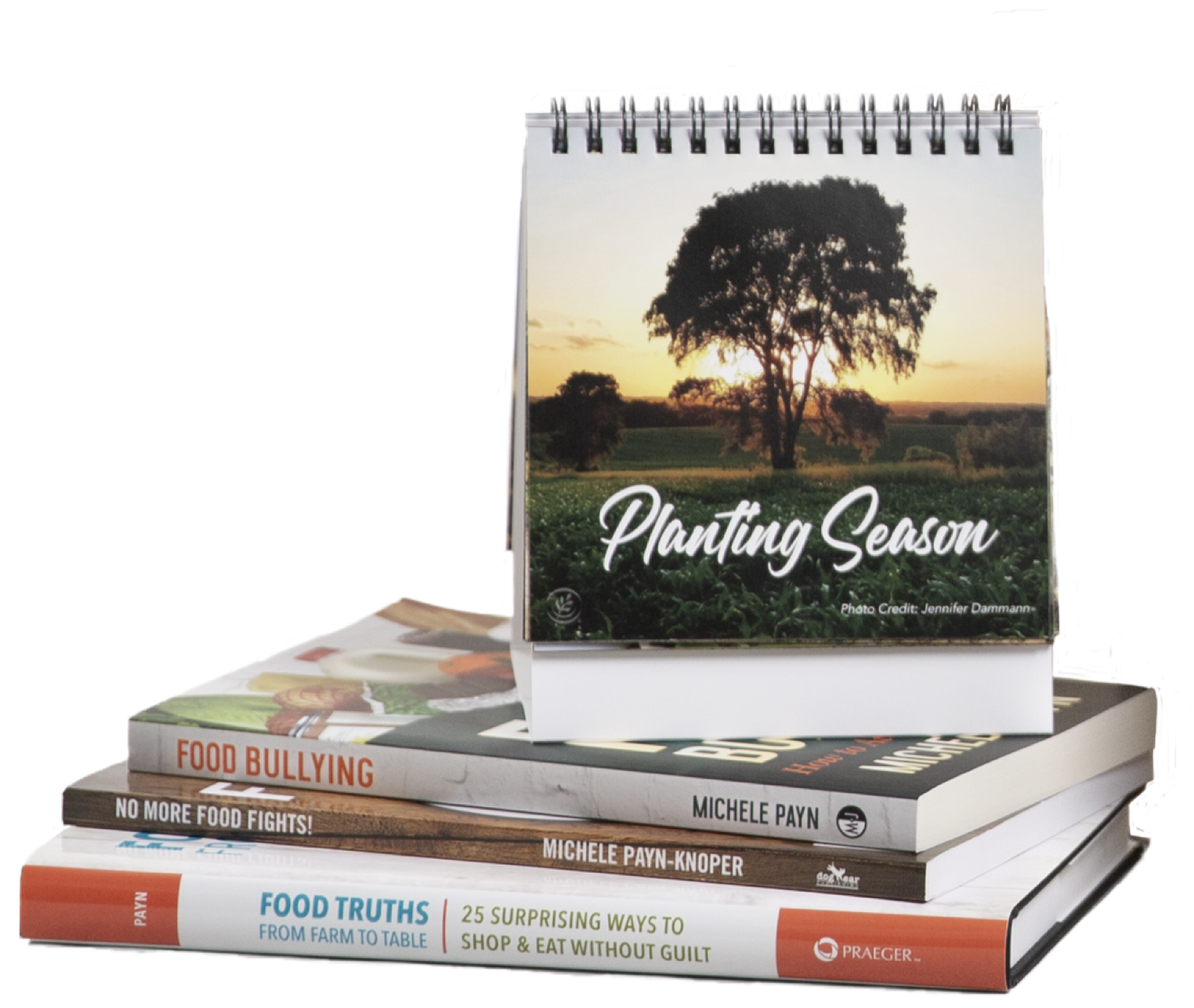
Michele Payn, CSP, is one of North America's leading voices in connecting farm and food. She is the author of four books including the IPPY Gold Medal-winning Food Bullying: How to Avoid Buying B.S. and Science Story Speak, a workbook for science communicators. She founded #AgChat and #FoodChat in 2009, pioneering social media advocacy in agriculture. A lifetime Holstein breeder and conservation farmer in Indiana, Michele has worked across six continents on agricultural communication, food truth, and the mental health of farming families.