



What really happens on a dairy farm – answers to the questions consumers are actually asking
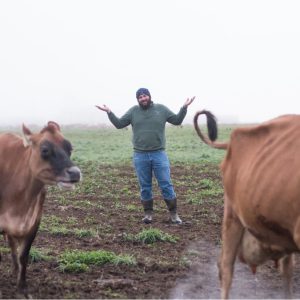 Derek Josi is approaching one million followers on Facebook. He survives, by his own description, on coffee and sarcasm. And when someone posts misinformation about dairy farming on his pages – whether it's about pus in milk, water usage, hormones, or animal welfare – he responds, because leaving it unanswered makes the person feel justified in staying ignorant.
Josi is a fourth-generation dairy farmer in Oregon, a farmer-owner of Tillamook Creamery, and one of the most-followed agricultural voices on social media under the name TDF Honest Farming. He also hosts his own podcast, The View From the Milk Barn. He returned to the Food Bullying Podcast to address the misconceptions that show up in his comments every day – the ones dietitians, healthcare professionals, and informed consumers need real answers to.
Is there pus in milk?
No. This is one of the most persistent myths in the dairy space, and it's built on a deliberate conflation of terms. Somatic cell count – a regulatory measure used to assess udder health in dairy cows – is not pus. Somatic cells are white blood cells present in all milk as a normal feature of mammalian biology. Conflating them with pus is a rhetorical technique, not a scientific statement. U.S. regulations set strict somatic cell count limits for saleable milk; milk that exceeds those limits is rejected. The milk in your grocery store has passed that test.
How much water does dairy really use?
The water usage statistics cited against dairy production are technically accurate and deeply misleading. When someone states that it takes hundreds of gallons of water to produce a pound of beef or a gallon of milk, they are counting all the rainwater that falls on the pastures and cropland used to grow cattle feed as part of the calculation.
Over 90% of the water attributed to dairy and beef production is precipitation – water that would have fallen on that land regardless of whether cattle were present. Counting rainfall as a production input and presenting it as a consumption figure is, as Josi puts it directly, using statistics in a shady way to push a lie. Dietitians and agricultural communicators who encounter this talking point can clarify the distinction between water consumed in production processes versus precipitation that falls on farmland as part of normal weather.
What "hormone-free" on a label actually means
Everything has hormones. Plants have hormones. Humans have hormones. Milk has naturally occurring hormones because it comes from a mammal. A label claiming a product is "hormone-free" is either scientifically inaccurate or referring to a very narrow definition that doesn't tell the full story.
Josi's response to this label is characteristically direct: the claim is misleading because it implies other products contain hormones that are somehow dangerous, when the reality is that naturally occurring hormones are present in virtually all food. The regulatory context matters too – additional growth hormone use in dairy cattle is a separate, regulated practice – but a blanket "hormone-free" label on milk doesn't communicate any of that nuance. It communicates fear.
What the rotary parlor actually is – and why cows fight to get on it
Josi recently moved his herd to a rotary parlor – what he describes as a merry-go-round for cows. Each cow steps onto a rotating platform, is milked during one full rotation of approximately nine minutes, and steps off when she's done. The entire milking takes seven to eight minutes. Then the cow returns to the barn and continues her day.
When a screen grab of the rotary without context circulates on social media, comments flood in about cows being kept in stalls and milked continuously. Clicking on the actual video disproves this in under ten seconds. The cows, Josi notes, are not reluctant participants – they sprint through the holding pen to get on. They've had to add a deterrent mat near the cows' shoulders to encourage them to step off at the end of their rotation, because otherwise they would simply ride around again.
Cow comfort, Josi emphasizes, is not a welfare aspiration on his farm – it's an economic necessity. A dairy cow that is stressed, uncomfortable, or not fed correctly will immediately produce less milk. Milk production pays the bills. The incentive structure of dairy farming aligns almost perfectly with good animal welfare.
Dairy alternatives are not dairy equivalents
This point matters particularly in the frozen and refrigerated aisles where consumers are increasingly choosing plant-based alternatives under the impression they're making a nutritionally equivalent or superior choice.
Josi's frustration is with the comparison method. Plant-based beverage marketing frequently compares a single nutrient – usually protein – in its product against dairy milk, claims environmental equivalence or superiority on that one basis, and ignores the eight essential vitamins and minerals present in dairy milk that are absent or present in much smaller amounts in the alternative. That's not a complete nutritional comparison. It's cherry-picking a single data point to support a predetermined conclusion.
The environmental comparison has similar problems. Plant-based meat and dairy alternatives are manufactured in energy-intensive processing facilities. The greenhouse gases released by those industrial processes – including fossil fuel combustion – persist in the atmosphere for over a thousand years. Cattle emit methane, a greenhouse gas that cycles through the biogenic carbon cycle and breaks down within approximately 12 years. Comparing these two as equivalent environmental harms, or claiming that plant-based production is categorically better for the environment, ignores fundamental differences in how these gases behave.
On the question of bioavailability: protein in dairy milk is highly bioavailable. Plant-based protein sources are not equivalent in bioavailability, which is why the DIAAS scores of dairy proteins consistently outperform plant alternatives. For patients making genuine nutritional choices, the comparison needs to account for what the body can actually use – not just what the label reports.
The sustainability story dairy isn't telling loudly enough
In the 1940s, the U.S. dairy herd numbered over 20 million cows. Today there are just over 9 million – less than half as many. Yet the industry produces four times the volume of milk. Fewer than a third of the cows producing four times the output represents a profound efficiency gain that rarely surfaces in environmental coverage of dairy.
That progress came from genetics. Dairy cattle have been selectively bred for nearly a century to optimize milk production, resulting in animals that look and perform very differently from their beef cattle counterparts. The industry's goal is to reach net zero emissions by 2030 – but the baseline for that goal already reflects decades of sustainability improvement that the public conversation consistently overlooks.
Josi is fourth-generation on his property. His planning horizon isn't next year's market – it's the next four generations of his family farming the same land. That long-term stake in the health of the land, the water, and the regional ecosystem is the actual driver of sustainability practices on family dairy farms. It doesn't require an external mandate.
The mental health cost of farming under constant attack
Josi is self-aware about the toll social media takes. He's been on the receiving end of personal attacks – about his weight, his practices, his character – from people who would never say those things to his face. His approach is to engage rather than ignore, because silence signals agreement to the audience watching, even when the commenter is arguing from a position of demonstrable ignorance.
But he's honest that it wears on you. The farming community faces a persistent and unfair burden: the people most affected by food misinformation – those whose livelihoods, mental health, and family legacies depend on consumers trusting what they produce – have the least time and platform to respond to the people generating that misinformation. The gap between how farmers are portrayed on social media and how they actually operate their farms is one of the most damaging features of the current food information landscape.
Connect with Derek Josi: Find him on Facebook, Instagram, and Twitter as TDF Honest Farming, and listen to his podcast The View From the Milk Barn.
Want to bring the real story of dairy farming, animal welfare, and busting food myths to your next event? Michele Payn speaks to agricultural organizations, agribusinesses, and healthcare associations on food bullying, dairy misconceptions, and the science behind modern farming. Book Michele to speak →