






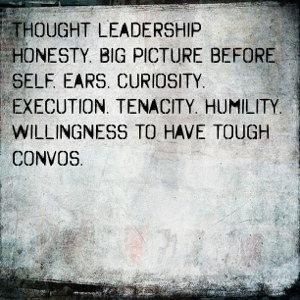
Thought leadership is a term thrown around in corporate environments, may be considered cliche by some or, as I’ve found, makes most people scratch their head. I’m not an expert and am not going to try to define thought leadership, but simply offer some observations on the human spirit – particularly those in agriculture.
- Honesty. It’s easy to pretend to be someone else in today’s social media driven society and some people who thrive on building false profiles. Don’t be anyone but you! It’s also easier to say that we do everything right in agriculture, that farmer & ranchers never do anything wrong and that pundits are crazy. None of those are true; an honest conversation starts with the acknowledgement of problems across the agrifood system.
- Big picture before self. Call me crazy, but today’s regulations and activist agendas will impact you – your family, your bottom line, your right to farm – in 5 or 10 years. Are you sure that you don’t have time to step up and help those who are working to give you a voice? Of course you need to take care of home fires, but don’t do so at the demise of the big picture of agriculture.
- Ears. Can you hear a question about agriculture or farming and really LISTEN? Do you automatically go into defense mode? Or are you coming up with your answer while the other person is talking. I find many agriculturists are incredibly defensive in the conversation around food. 98.5% of the population aren’t on a farm; they sometimes simply have a question. Thought leaders ask others questions and listen closely to the answers.
- The long view. Long-term thinking. Looking beyond your own business. Understanding global demands. Considering the impact of policy, activism, markets that impact all of agriculture. If pork producers are having a major issue and you’re a dairy person, do you turn a blind eye? Or do you step up because of the implications for all of agriculture?
- Passion. It acts as a magnet. It propels a movement. It engages a community. Thought leaders have the ability to channel their passion for the good of the greater cause.
- Curiosity. Children thrive on it, adults bury it. Sometimes the simple act of asking “why?” can lead you down an entirely different path-a path of greater impact. And more importantly, it will help you discern what’s important to the people you’re trying to talk to about agriculture.
- Execution. If you don’t have the ability to put wheels under ideas – and involve others in pulling the wagon, you don’t have a lot. Bright shiny objects are fun, but they become dull over time and get put away in the back of the closet. Only those who can execute and grow ideas are true leaders.
- Open mind. “There exist limitless opportunities in every industry. Where there is an open mind, there will always be a frontier.” said Charles Kettering. Many think North America’s greatest days of innovation are in the past. I disagree; find a frontier desperately in need of thought leadership. Agriculture is ripe with those opportunities; look at the technologies, businesses, communities, techniques available to you now that didn’t exist five years ago. Be open enough to find a way to adapt them for the benefit of the big picture.
 Tenacity for the long haul. Producing food, fuel, feed and fiber isn’t an easy business. Weather works against you. So do agendas around a myriad of issues, often fueled by misinformation. But always know that one small voice, a single picture, or a tweet may just capture the attention of thousands – and put a face on farming.
- Guts enough to accept change – and preferably embrace it. You’re as young as you’re ever going to be today – are you really sure you want to spend your life complaining about change? Many reference their age in not doing well in social media, but I’ve seen 60 year-old grandpas outpace 25 year-old guys in using Facebook. Don’t use your birthdate, position or embarrassment prevent you from adapting to change!
- Humility enough to admit when you’re wrong and apologize when needed. There’s not a better teacher of this than being a parent. Humility is rare in those holding leadership positions, but the few who possess can lead a movement as servant leaders.
- Optimism. If you don’t believe in a better tomorrow, why bother?
- Willingness to have the tough conversations. Is local and organic better? Do we still need subsidies? Why is your farming practice better than mine? Do consumers have a right. Difficult, but thought leadership is about leading the conversation – not reacting to it. It’s also about taking the high road even when others sink to the gutter.
Truthfully, I’d like to see more true thought leadership in agriculture. We all sing to the choir that we have to do things differently, so how about we actually put muscle where our mouth is?
0 Comments