...
Growing freshness from the ground up
read more...


“Her presentation empowers agriculture to tell its story with credibility, respect, and impact. Michele helped me navigate tough conversations with compassion for the urbanites who have little connection to where their food comes from.”
- Jeannette Andrashewski, Canadian Canola Farmer


What drives Michele to write? ▶ Bridging the gap from farm to food with story and science.


"You are a gift to agriculture – you do an amazing job connecting non-ag folks to agriculture in a relatable and logical way that's welcoming and opens the door to a deeper understanding.”
- Lana Frantzen, PhD, RDN, DairyMAX

...
Big picture before self, the long view, execution, humilty, guts enough to accept change and ears. Michele asks if agriculture has true thought leadership and offers a few suggestions for farmers, ranchers and agricultural advocates to lead the conversation rather than react to it.
Exercise is a privilege, and health is an investment. Sure, it’s easier to sit on the couch and with potato chips and ignore nutrition, but what you invest in your body today pays off years later. That is true in both food and exercise.
Watch Michele & Carolyn discuss farming choices...
"To make the best better" involves a lot of...
People who care for animals do so with...
...
Meg, a friend and fellow professional speaker...
Last night brought the unfortunate news about...
...
Is it really possible a label on food is...
Meet Tyson Roberts, a vegetable grower...
Chemicals are bad, right? Not quite....
...
...
The first time I visited Hawaii and discovered...
Imagine a $5.75 trillion playground with 40,000...
...
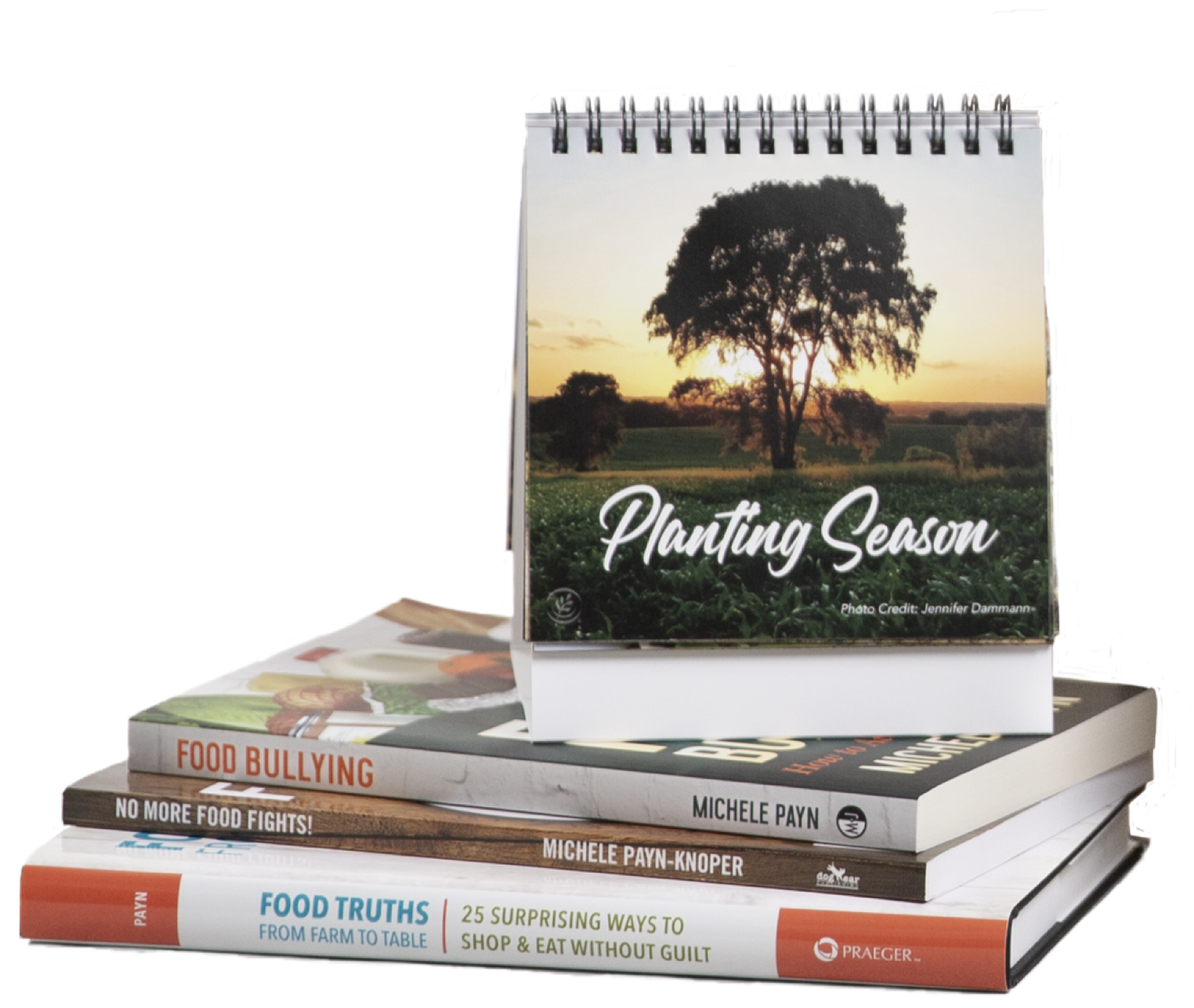
The fascination for finding the “perfect” food story that makes the “right” social statement has led to an inability to discern B.S. from meaningful information. I wrote this book to equip you to find the signposts of food bullying, make more rational decisions, and avoid buying B.S. on the chaotic food playground.
What technology do you use every day? I’m...
Lard or butter? Coconut oil as the saving grace?...
Each...
...
Remember the first time you heard a...
Most adults don’t take the time to remember the lessons of their childhood games, but there are a wide variety of creative tools available on the farm.
W My visit to South Africa is a memory I’ll...
Local food makes sense, right? Food that’s grown...
Ninety-two percent of Americans consider it...
In a society where we embrace rodents as cartoon...
Do you enjoy the thought of hormones? As a...
It seems we have moved beyond mere concern about...
Have you ever felt judged for what’s in your grocery cart? Do you wonder whether GMO-free, gluten-free, antibiotic-free, fat-free milk is better than regular milk? Are “natural” Fritos better for you? Does anyone really need organic, natural, hormone-free cat litter? Grocery store marketing is full of food claims that are B.S. (below standard). Five ways to avoid buying B.S. food.
Just as “This Is Us” has created hysteria around slow cookers, “documentaries” have created hysteria around meat and milk. Are we really so unaware the difference between fiction and good television that we can’t recognize reality?
Seeds planted by teachers last a lifetime, whether good or bad. Marketing and bias should not trump science and well-rounded debate in the classroom. Teacher bias deserves the same concern as journalistic bias – a student will never be able to turn off their education the way so many of us have silenced the news. A look at the aftermath of a Chipotle video showed by a 7th grade social studies teacher.
If you’ve never experienced a fair from the inside, it’s like final exams and Christmas all wrapped into an intense one or two weeks filled with more sweat and dirt than you can imagine. It’s both exhausting and exhilarating. I have been involved in fairs my entire life, but am always amazed watching 4-H and FFA members learn life lessons through the trials of diligently preparing a project, talking with a judge and then nervously anticipating the outcome. Sometimes, the ribbon is blue. Other times it’s red. And if they’re lucky, the coveted purple or pink ribbons may be put on a project.
The reality is that ribbons fade and are eventually stashed away in boxes, forgotten about. It’s the stories behind the ribbons that are remembered for a lifetime. A look at the care and respect young people give their animals behind the scenes at the fairgrounds.
Why is grass seed grown in Oregon? Is it good...
As summer’s heat turns up, any drive across the Midwest will feature corn outside the window. Why do farmers grow corn? Justin and Jennifer Dammann sat down at their kitchen table with Michele to talk about how they make choices in growing corn, soybeans, and beef as family farmers.
Does social media still give you a headache? Feeling frazzled by Facebook? Troubled by Twitter? Michele would really love to hear your ideas about what you need to learn next about any of the social networking tools to build better connections between farm gate and consumer plate. We’re developing some virtual learning products here at Cause Matters Corp. as a part of the continued emphasis on improving agvocacy skillsets-vote to add your ideas.
Do farmers pour chemicals on our fruit? How do we know apples are safe? In addition to explaining why he uses certain practices in growing apples, Michigan farmer Jeff VanderWerff talks with Michele on camera about the stringent standards and audits of fruit farmers. You can learn more about his apple growing practices in Food Truths from Farm to Table: 25 Ways to Shop & Eat Without Guilt.
Confusion and emotionalism has have made food a battleground. The marketing is getting bigger. The misinformation grows. Activists continue to bully. Celebrities and politicians take opinion-based positions instead of looking at the facts. Food shaming persists. As a result of all of this, food buyers are filled with guilt and, confusion, and/or are overwhelmed.
Food is a basic necessity. We eat to sustain life. Not to make a political statement. Not as a status symbol. Not because of a claim on a package. Food is sustenance. An inside look at a new book to help us return to that fundamental belief.
Drones flying over fields? Technology in food production? UAV cameras monitoring crops? All of these are reality on Matt Boucher’s farm in Illinois. This corn and soybean grower talks about how he uses technology in food production and why it helps him be a better steward of the land.
Did you know hogs establish a hierarchy? Or that keeping farm animals in barns protect them from disease, predators and weather extremes? Wanda Patsche, a hog farmer in Minnesota, sat down to talk about pigs with Michele. Watch their video to learn more about animal welfare, bacon bullies, and why hog farmers do what they do.
Greg Peterson, of Peterson Farm Brothers fame, talks about the use of technology on the farm and the choices across the world in how to raise food. Watch to hear the insight he’s gained from traveling and working with farmers who choose organic, GMO and conventional farming practices.
Why should farmers and dietitians work together? Building bridges between the people growing food and those making nutrition recommendations is critical. Watch Michele talk with registered dietitian Cara Harbstreet.
Simplify your grocery shopping and choose meat with confidence after watching Jennie Hodgen, a meat scientist, mom and farmer share her expertise. She even tells you how to find out where your meat comes from!
Get your food information straight from farmer Brian Scott, as Michele Payn visits with him in his Indiana field. This video covers intellectual property, technology and if farmers are controlled by corporations, as well as links to a live streaming interview.
Two moms with unique insight on food and...
Humor evokes emotion. Emotion results in human connection. Connection piques curiosity. We don’t have to explain the complex business of farming in one line; we simply have to create a human connection.
Last month we announced 15 Cause Forward awards will be given to organizations working to bring clarity and reduce confusion about how food is grown. The first three awards have been given, including a county Farm Bureau from Michigan, an integrated food and agriculture company in Canada and an association in Indiana. Do you know of a group who would like to join Michele to help grow an understanding of how food is grown?